To run a flash sale, pick one thing to sell, one honest deal and one real deadline, usually 48 hours. Tell your email list and followers a day ahead, send four short emails and a few posts while it runs, and end it exactly when you said you would. Then look at who bought and send them something useful next.
A flash sale is a short sale with a hard stop. It works because the deadline gives people a reason to decide today instead of someday. That's also why it stops working the moment your deadlines stop being real.
Here's the whole plan, step by step, with the emails and posts laid out hour by hour.
// 01What is a flash sale?
A flash sale is a discount or bonus that lasts a short, fixed time, usually somewhere between a few hours and three days. For a small business, 48 hours is a good default: long enough that people who check email once a day still see it, short enough that it feels like now.
| Length | Good for | Watch out for |
|---|---|---|
| A few hours | Your most loyal customers, a surprise for your list | Most people miss it |
| 24 hours | A one-day event tied to a date | One email sent at the wrong time and half your list never sees it |
| 48 hours | Most small businesses | Needs a plan for day two, not just a launch email |
| 3 days or more | Bigger events like Black Friday weekend | Starts to feel like a normal sale |
// 02Step 1: Pick the reason and who it's for
Every good flash sale has one reason behind it. Write it down before you pick a discount, because the reason decides who hears about it.
| Reason | Who it's for | Example (illustrative) |
|---|---|---|
| Bring back past customers | People who bought once and haven't come back | A thank-you deal for anyone who bought last spring |
| Get first-time buyers off the fence | Your email list and followers who haven't bought | A first-order deal for subscribers only |
| Clear out stock or open slots | Anyone who's bought something similar | Last season's colors, or empty appointment times next week |
| Warm people up before a big sale | Everyone, ahead of Black Friday | A short "early bird" sale five weeks out |
Pick one. A sale that tries to do all four ends up with a muddy message and a deal that's too big.
// 03Step 2: Pick one honest deal
Keep the deal simple enough to say in one line: "20% off everything until Friday at midnight." If people have to do math to understand it, they won't.
| Deal type | Best when | Keep in mind |
|---|---|---|
| Percent off | You sell a few products at similar prices | Check your margin on the cheapest item first |
| Dollars off | One product or service | Easy to say in a subject line |
| Free bonus with purchase | You'd rather not cut your price | The bonus has to be something people actually want |
| Bundle | You have things that go together | Show what each piece would cost on its own |
Two honesty rules matter here. The "regular price" you compare against has to be a price you actually charged, out in the open, for a real stretch of time. The US Federal Trade Commission's pricing guides call an inflated "before" price, set up just to make the discount look bigger, a false bargain. And if you say the deal is limited, it has to be limited. The same guides name a "limited" offer that isn't really limited as a deceptive practice.
// 04Step 3: Set a real deadline and keep it
Pick an exact end time with a time zone: "Ends Friday at 11:59 PM Eastern." Put it in every email, every post and on the sale page.
Then end it on time. Don't extend it because sales were slow. The first time you stretch a deadline, your list learns that your deadlines don't mean anything, and every sale after that gets weaker. If it went badly, end it, learn from it, and run a better one next month.
// 05Step 4: Map out the 48 hours
This is where most flash sales fall apart. People send one email at the start and hope. The table below is an illustrative schedule for a sale that opens Tuesday at 12:01 AM and ends Wednesday at 11:59 PM. Shift the times to fit your week.
| When | Social post | |
|---|---|---|
| Monday, afternoon | Heads-up: "Tomorrow at 9 AM, 20% off for 48 hours" | Story or post: "Something's coming tomorrow" |
| Tuesday, 9 AM | It's open: the deal, the deadline, one button | Post with the deal and the end time |
| Tuesday, evening | Reminder: a reason to buy, a customer question answered | Story showing the product in use |
| Wednesday, morning | Last day: "Ends tonight at midnight" | Post: "Last day" |
| Wednesday, about 8 PM | Final hours: short, just the deadline and the button | Story: "A few hours left" |
| Thursday | No sale email. Thank your buyers | Thank-you post, no discount |
That's five emails including the heads-up. It feels like a lot when you're the one sending them. Your subscribers won't read every one, so each email has to make sense on its own.
// 06Step 5: Write the emails
Keep each one short. One idea, one deadline, one button. Here are illustrative subject lines you can adapt:
| Subject line (illustrative) | What goes in it | |
|---|---|---|
| Heads-up | Tomorrow: 20% off, 48 hours only | What, when it starts, when it ends |
| Open | It's on: 20% off until Wednesday at midnight | The deal, the deadline, the button |
| Reminder | The question I get most about [your product] | Answer one real customer question, then the deal |
| Last day | Last day for 20% off | The deadline, front and center |
| Final hours | A few hours left | Two sentences and the button |
Send to people who signed up, not a bought list, and give them an easy way to unsubscribe. If you don't have a list yet, start one before your next sale. My post on the four emails to send new subscribers shows how to welcome the people who join.
// 07Step 6: Get ready before you open
A flash sale that breaks halfway through is worse than no sale. The day before, check these:
| Check | How |
|---|---|
| The discount code or sale price works | Buy something yourself, or run a test order |
| The sale page shows the end time | Open it on your phone |
| You have enough stock or open slots | Count them, and decide what happens when they run out |
| Someone answers questions fast | Pick who checks email and messages during the sale |
| The deal turns off on time | Set the end date in your store, or put a reminder on your phone |
// 08Step 7: After the sale, look at three things
Give it a day, then look at:
- How many orders came in, and from where. Email, posts, or people who came back on their own.
- New buyers versus returning buyers. If most were past customers, the sale brought people back. If most were new, it got people off the fence.
- Who signed up during the sale but didn't buy. They're your warmest people for the next one.
Then send every new buyer something that isn't a discount: a how-to, a thank-you, a tip for getting the most out of what they bought. A flash sale that trains people to wait for the next discount isn't helping you. One that turns first-time buyers into regulars is.
// 09A small candle shop's flash sale (illustrative)
This example is made up to show the method. It isn't a real business or real results.
A one-person candle shop sells online and has about 1,200 people on its email list. Fall scents are selling slower than expected, and the owner wants to move them before the holiday rush.
| Decision | What they picked |
|---|---|
| Reason | Clear fall stock and bring back last year's buyers |
| Deal | 25% off the fall collection only |
| Deadline | Tuesday 12:01 AM to Wednesday 11:59 PM Eastern |
| Emails | Heads-up Monday, open and reminder Tuesday, last day and final hours Wednesday |
| Posts | Instagram post at open, two Stories a day, "last day" post Wednesday |
| After | A "how to make a candle burn evenly" email to every buyer the next week, no discount |
Notice what's not here: no sitewide discount, no extension, no countdown that resets. The reason is clear, the deal is easy to say, and the deadline is real.
// 10Should you run a flash sale before Black Friday?
It can help, as long as it's small and honest. A short sale about five weeks out lets you test your emails, your checkout and your deal while there's still time to fix them. Keep the deal smaller than whatever you plan for Black Friday on Nov 27, so you don't undercut your biggest weekend. For the big weekend itself, see my Black Friday email examples.
// 11Where SAM fits (built by the founder of SamCart)
SAM is SAM + 5 AI specialists: Ads, Content, Designer, Promotions and Social. It's built by the founder of SamCart, and it handles the busy work a flash sale piles onto one week.
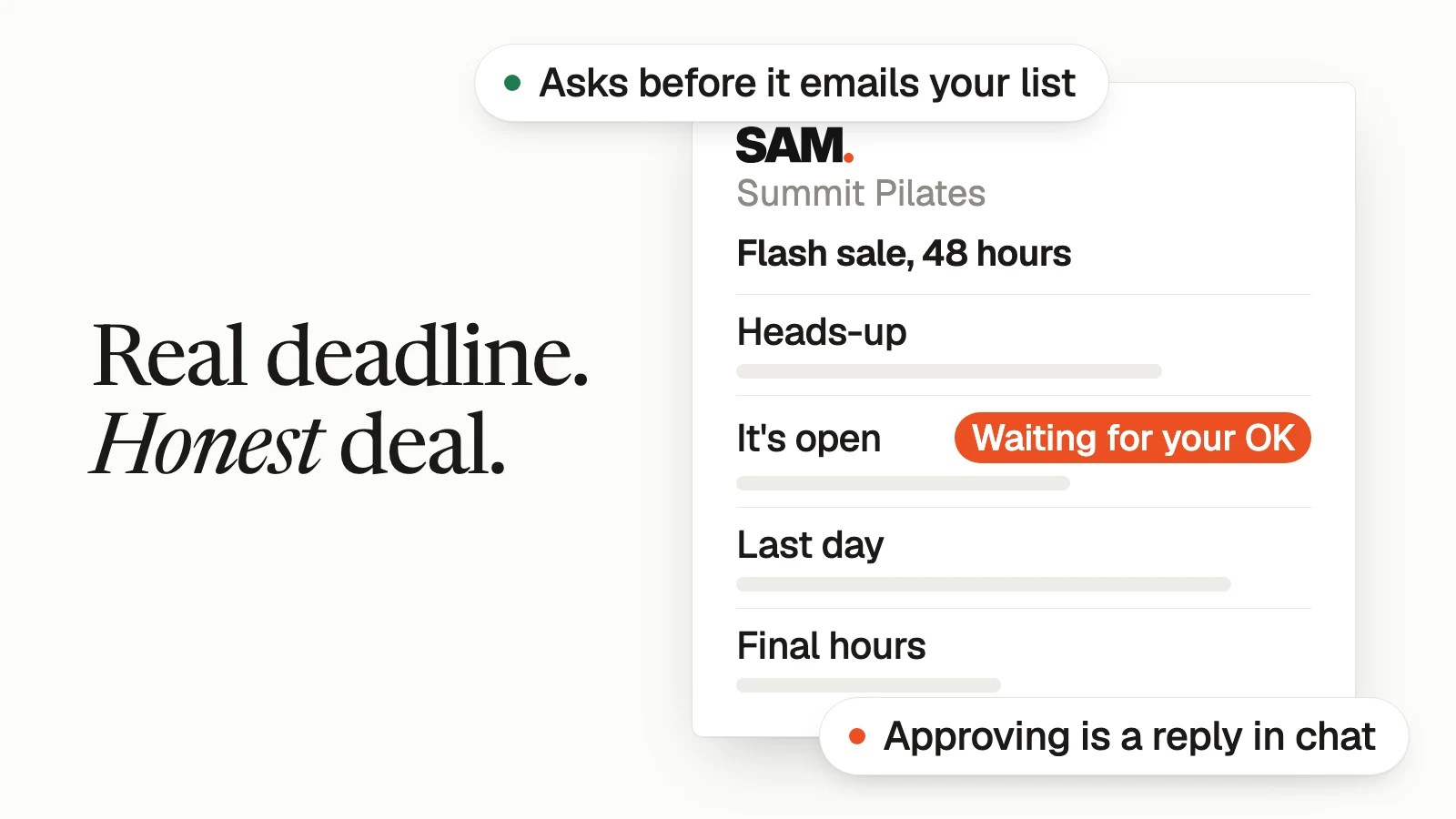
On setup, it learns your brand and offer from your website, and your customers and sales from the accounts you connect. Then you ask in plain words. SAM writes the emails and posts in your brand voice and makes the images and short videos you need. It sends email campaigns through Kit, Mailchimp, MailerLite and ActiveCampaign, and asks before it sends to your list. It publishes to Instagram and asks first, and it can schedule a post for a set time. After the sale, it reads your real numbers from the tools you've connected and reports back in plain English.
Its Flash Sale Promo playbook is one example of how this works: it pauses for your OK partway through. What's available is shown when you get access. Approving is a reply in the chat, from your phone if you like.
SAM opens to a limited group first. Until it opens to you, let SAM score your marketing. It's free.
SAM isn't open to you yet. Let it score your marketing.
Let SAM score my marketing// FAQFAQ
How long should a flash sale last?+
For most small businesses, 48 hours. That's long enough for people who check email once a day to see it and short enough to feel urgent. Go shorter only for a surprise to your most loyal customers.
How big should the discount be?+
Big enough to be worth acting on and small enough that you still make money on every order. Work out your margin on the cheapest item in the sale first. A free bonus can work instead of a price cut.
How many emails should I send during a flash sale?+
About five for a 48-hour sale: a heads-up the day before, one when it opens, a reminder in the middle, one on the last day and a short one in the final hours.
Can I extend a flash sale if it isn't working?+
You can, but don't. Once your list sees a deadline move, they stop believing your next one. End it on time and run a better one later.
How often should I run a flash sale?+
Not so often that people wait for it. A few times a year, each with its own reason, keeps them special. If customers start asking when the next sale is before they'll buy, you're running them too often.
// 12Your one thing this week
Pick the one reason you'd run a flash sale right now, bring back past customers, get first-time buyers off the fence, or clear out stock. Write the deal in one line and the end time with a time zone. Then put the five emails on your calendar.
When you want a team that writes and sends the whole thing for you to approve, let SAM score your marketing.
// SRCSources
| Source | What it supports |
|---|---|
| 16 CFR 233.1, Former price comparisons (FTC Guides Against Deceptive Pricing) | A "before" price must be a real price offered openly for a reasonably substantial period; an inflated former price makes the bargain a false one |
| 16 CFR 233.5, Miscellaneous price comparisons (FTC Guides Against Deceptive Pricing) | Advertisers shouldn't make a "limited" offer which, in fact, is not limited |
| getsam.bot homepage | SAM + 5 AI specialists; free marketing audit; built by the founder of SamCart |