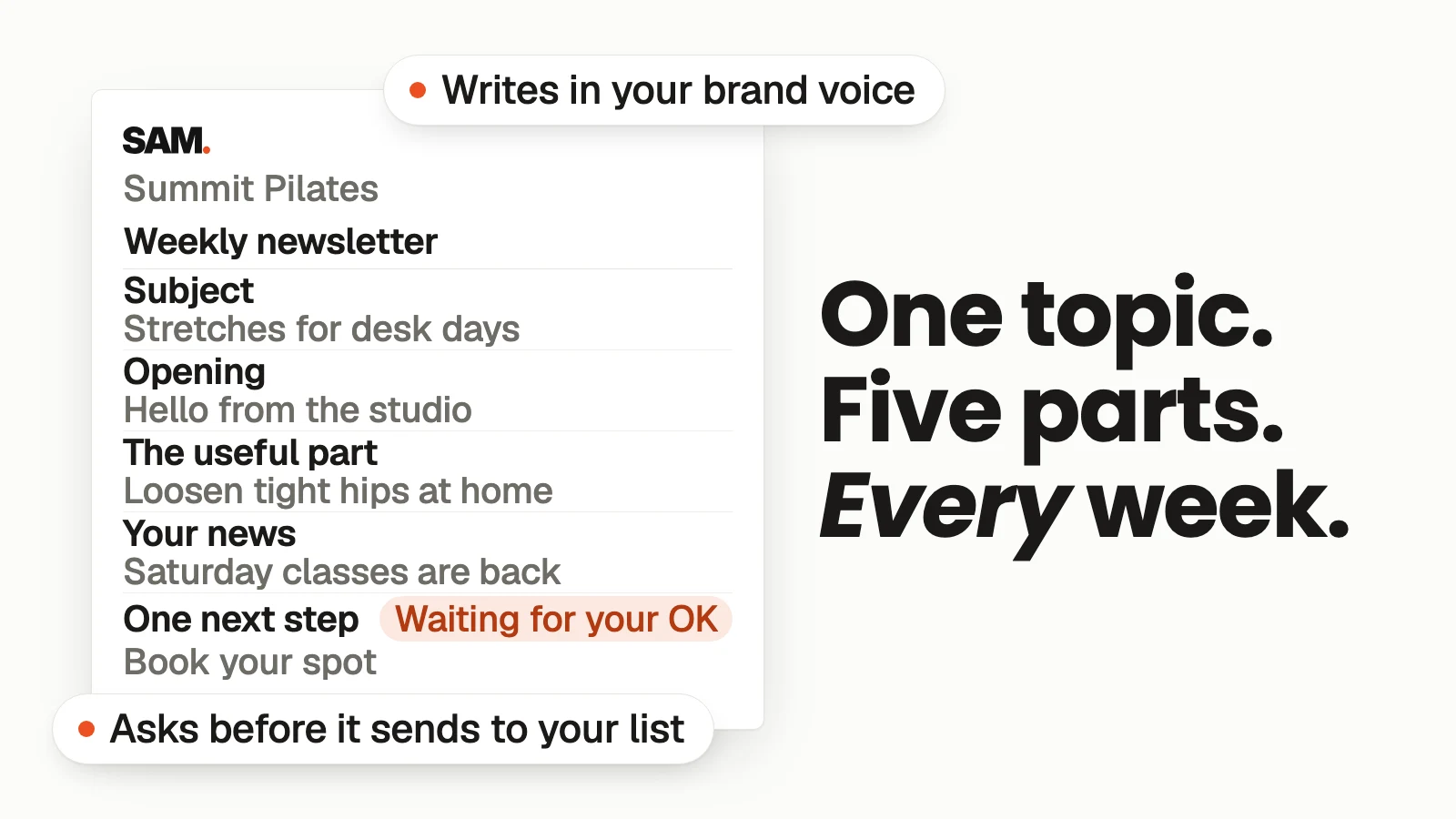
A small business newsletter works best when it's short, comes out on the same day every week, and covers one useful topic. Open with something your reader can use today, add one bit of news from your business, and end with one clear next step. Pick a day you can keep, write it in your own voice, and send it to people who asked to hear from you.
Most small business owners know they should send a newsletter. Most of them start strong, send three issues, then go quiet for six months. The problem usually isn't writing. It's that every issue feels like starting from a blank page.
The fix is a simple, repeatable shape. Once you have it, a weekly newsletter takes about an hour, and your list starts to expect you in their inbox.
// 01What is a small business newsletter?
A newsletter is a regular email you send to people who signed up to hear from you. Customers, past buyers, people who grabbed a freebie on your site. It's different from a sales email in one big way: most of it is there to help, not to sell.
| Newsletter | Sales email | |
|---|---|---|
| Main job | Keep people close and trusting you | Get a purchase now |
| How often | Same day, every week or two | When you have a sale or launch |
| Mostly | A useful tip, a story, one piece of news | The product, the deadline, the reason to buy |
| Asks for | One small next step | The sale |
If you just got someone's email address, start with a short welcome email sequence first. The newsletter is what they get after that, every week, for as long as they stay.
// 02Why a newsletter is worth it for a small business
Social media posts reach whoever the platform decides to show them to. An email list is yours. When you send a newsletter, it goes to the people who asked for it, and nobody can turn that off but them.
A steady newsletter also does a quiet job: when someone on your list is finally ready to buy, you're the name they remember. That's why the habit matters more than any one great issue.
// 03The one-topic newsletter format
Every issue gets the same five parts. Keep the order the same each week so your readers know what to expect and you never stare at a blank page.
| Part | Length | Job | Example (illustrative, neighborhood bakery) |
|---|---|---|---|
| Subject line | Under about 50 characters | Get the open | "The 10-minute trick for crispier sourdough" |
| Opening | 2 to 3 sentences | Say why this week's topic matters | "A few of you asked why your loaves come out soft. It's almost always one thing." |
| The useful part | 150 to 300 words | One tip, how-to or answer they can use today | The trick, in three plain steps |
| Your news | 1 to 3 sentences | One thing happening at your business | "Pumpkin loaves are back Friday." |
| One next step | 1 sentence and a link | Tell them exactly what to do | "Reply and tell me what you're baking this weekend," or "Pre-order a pumpkin loaf here." |
One topic per issue is the rule that keeps it easy. If you have three tips, you have three weeks of newsletters.
// 04How to write your newsletter, step by step
Step 1: Pick your day and stick to it
Choose a day and time you can keep for the next three months. Tuesday morning, Thursday at lunch, whatever fits your week. Being steady matters more than the exact day.
Step 2: Keep a running list of topics
Every time a customer asks a question, write it down. Every question is a newsletter. Other good sources: the mistakes you see people make, how you do something behind the scenes, and what's coming up this season at your business.
Step 3: Write the useful part first
Start with the middle, the part that helps. It's the hardest part, and once it's done, the opening and the subject line are easy to write around it.
Step 4: Write it like you talk
Write to one person, not "valued customers." Short sentences. Your own words. If you wouldn't say it across the counter, don't write it in the email.
Step 5: Add your news and one next step
Pick one thing happening at your business and one action for the reader. Only one. A newsletter with five links usually gets zero clicks.
Step 6: Write three subject lines and pick one
Write three and choose the one that makes you most curious. Plain and specific usually beats clever. "How to keep cut flowers alive a week longer" tells people exactly what they get.
Step 7: Send a test, then send it
Send it to yourself first. Check it on your phone, since that's where a lot of people will read it. Click every link. Then send.
// 05Newsletter ideas when you're stuck
| Idea | Example (illustrative) |
|---|---|
| Answer a customer question | A plant shop: "Why your snake plant's leaves are turning yellow" |
| Show behind the scenes | A coffee roaster: "What happens to the beans before they hit your cup" |
| Share a quick how-to | A personal trainer: "A 10-minute workout for a hotel room" |
| Name a common mistake | A house cleaner: "The cleaning spray that's dulling your counters" |
| Get ready for the season | A landscaper: "Three things to do in your yard before the first frost" |
| Spotlight a product, honestly | A bookstore: "The one book our staff keeps buying for friends" |
// 06The rules you have to follow
In the US, commercial emails fall under the CAN-SPAM Act. The FTC's guide for business spells out a few basics every newsletter needs:
- A subject line that isn't misleading about what's inside.
- Your valid physical postal address.
- A clear way to opt out, and you have to honor opt-out requests within 10 business days.
Most email tools, like Kit, Mailchimp and MailerLite, put an unsubscribe link and your address in the footer for you once you set them up. Just send to people who signed up. A list you bought or scraped is a fast way to land in spam.
// 07Common newsletter mistakes
| Mistake | Fix |
|---|---|
| Sending only when you have a sale | Same day every week, mostly helpful |
| Cramming in five topics | One topic per issue |
| Writing like a press release | Write to one person, in your own words |
| Five links and buttons | One next step |
| Clever subject lines that hide the topic | Plain and specific |
| Quitting after three issues | Keep a topic list so you never start from scratch |
// 08Where SAM fits (built by the founder of SamCart)
SAM is SAM + 5 AI specialists: Ads, Content, Designer, Promotions and Social. It's built by the founder of SamCart, and it can take the weekly newsletter off your plate.
On setup, it learns your brand and offer from your website, and your customers and sales from the accounts you connect. Then you ask in plain words. SAM writes newsletters and other emails in your brand voice. With Kit, Mailchimp, MailerLite or ActiveCampaign connected, it can send your campaigns, and it asks before it sends to your list. It can also draft and publish posts on beehiiv. You can also describe a recurring job in chat, like a newsletter draft every week, and SAM sets it up. You can pause, edit or stop it anytime.
Approving is a reply in the chat, from your phone if you like.
SAM opens to a limited group first. Until it opens to you, let SAM score your marketing. It's free.
SAM isn't open to you yet. Let it score your marketing.
Let SAM score my marketing// FAQFAQ
How often should a small business send a newsletter?
Once a week is a good rhythm if you can keep it. Every two weeks is fine too. Pick the pace you can stick with for months, because a steady newsletter beats a busy month followed by silence.
How long should a newsletter be?
Short enough to read in a couple of minutes. One useful part of 150 to 300 words, a line of news and one next step is plenty.
What should I put in my first newsletter?
Say hello, tell people what they'll get from you and how often, and give them one useful tip right away so the first issue is worth opening.
Do I need my address in every newsletter?
In the US, yes. The FTC's CAN-SPAM guide says commercial emails need your valid physical postal address and a clear way to opt out. Most email tools add both to the footer for you once you set them up.
What's the best day to send a newsletter?
The day you can keep. There's no magic day for every business. Pick one, send on it every week, and look at your open rates after a couple of months.
// 09Your one thing this week
Write down five questions customers asked you this month. That's your next five newsletters. Pick the easiest one, write the useful part first, and send it on the day you choose.
When you want a team that writes the newsletter for you to approve every week, let SAM score your marketing.
// SRCSources
| Source | What it supports |
|---|---|
| CAN-SPAM Act: A Compliance Guide for Business (FTC) | Commercial emails need non-misleading subject lines, a valid physical postal address and a clear opt-out; opt-outs honored within 10 business days |
| getsam.bot homepage | SAM + 5 AI specialists; free marketing audit; built by the founder of SamCart |