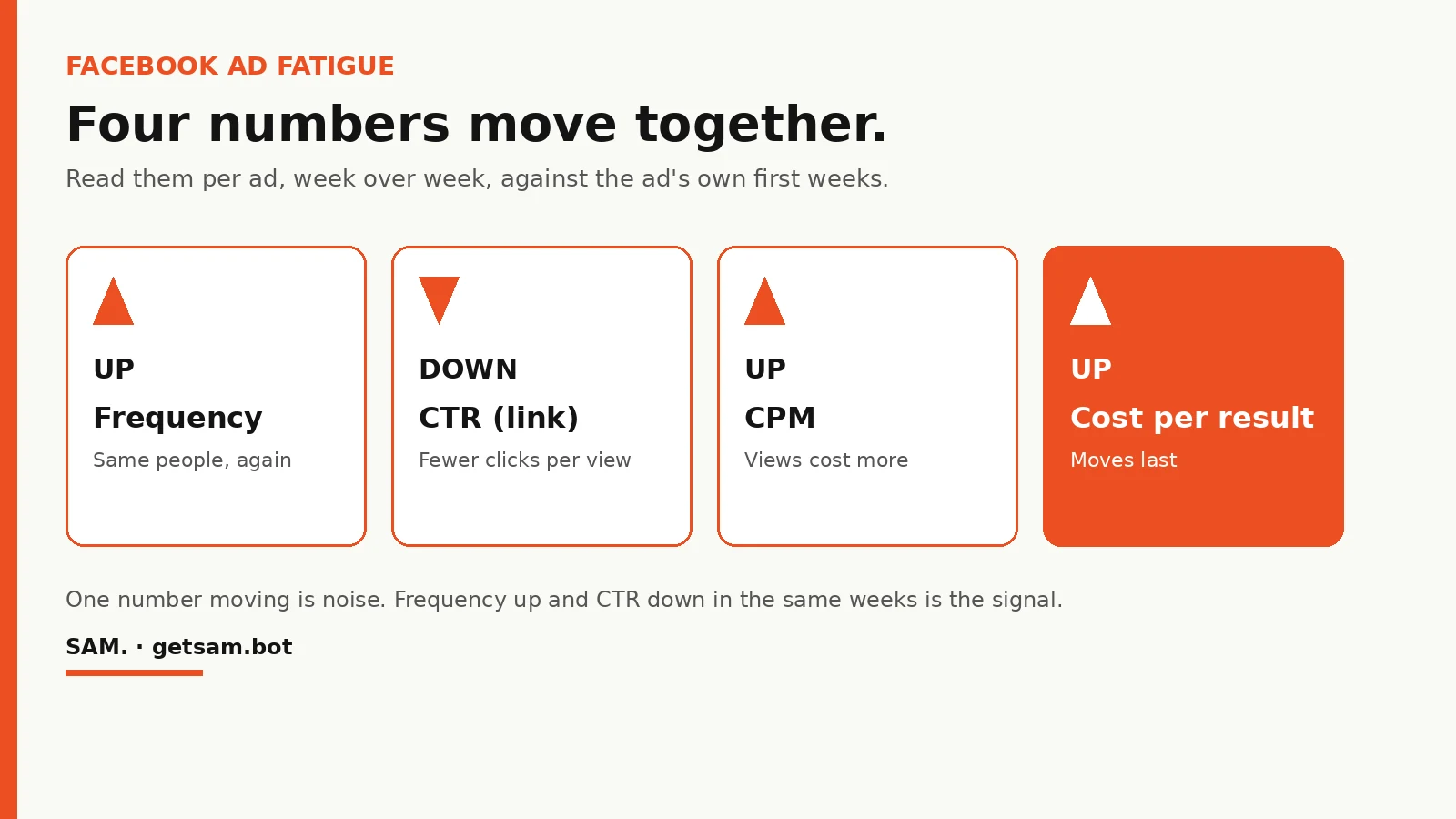
Facebook ad fatigue is when the same people have seen your ad so many times that they stop responding, so frequency climbs while click-through rate falls and cost per result goes up on that one ad. If all three move the wrong way together, week over week, make a new ad that's genuinely different. If only one moves, you probably have a different problem, and a new creative won't fix it.
That second part is where most people lose money. They see a bad week, blame "fatigue," swap the image, and the real problem (the offer, the page, the auction, the tracking) keeps running. This post gives you the four numbers to check, a simple way to tell fatigue from the other problems, and a made-up worked example you can copy.
// 01What is Facebook ad fatigue?
Meta's own definition is short: creative fatigue happens when an audience has seen the same creative too many times, so people are less likely to engage, which can push your cost per result up. Frequency is the number that tracks it. It's the average number of times each person saw your ad, and Meta says it may average 1 to 2 per ad set or run much higher, depending on your budget, audience size and schedule.
So there's no magic frequency where an ad dies. A big cold audience can take a lot of views. A small retargeting audience burns out fast because the same few thousand people keep seeing it. Meta's advice is to watch frequency next to your results, and that's the right way to think about it.
// 02What do "Creative limited" and "Creative fatigue" mean in Ads Manager?
They're Meta's built-in fatigue warnings, and they show up in the Delivery column for an ad set or ad. Meta looks at recent exposures of that image or video, including from your other campaigns on the same Page, and at your cost per result:
- Creative limited means the ad's cost per result is higher than ads you ran in the past, but less than twice as much.
- Creative fatigue means the cost per result is at least twice as much as your past ads.
Two catches. First, these labels only appear for ad sets with one creative (with a few exceptions, like Advantage+ catalog ads and dynamic creative). If you run several ads per ad set, you may never see them. Second, they're based on cost per result, which is the last number to move. By the time an ad says "Creative fatigue," you've already been paying double. Treat the label as a confirmation, not an early warning.
// 03The four numbers to check
Open Ads Manager at the ad level, not the campaign level. Break the date range into weeks and compare each ad to its own first good week, not to some benchmark you read online.
| Number | What it tells you | What fatigue looks like |
|---|---|---|
| Frequency | How many times the average person saw the ad | Climbing week after week |
| CTR (link) | How many people who see it still care enough to click | Falling against the ad's own first weeks |
| CPM | What you pay for 1,000 views | Rising on this ad more than on your others |
| Cost per result | What a lead or sale costs you | Rising, usually last |
One number moving is noise. Frequency up and CTR down in the same weeks is the real signal, and cost per result climbing right behind them confirms it. If frequency is rising but CTR and cost per result are holding steady, the audience is still responding. Leave it alone.
// 04Is it fatigue, a bad offer, or the auction?
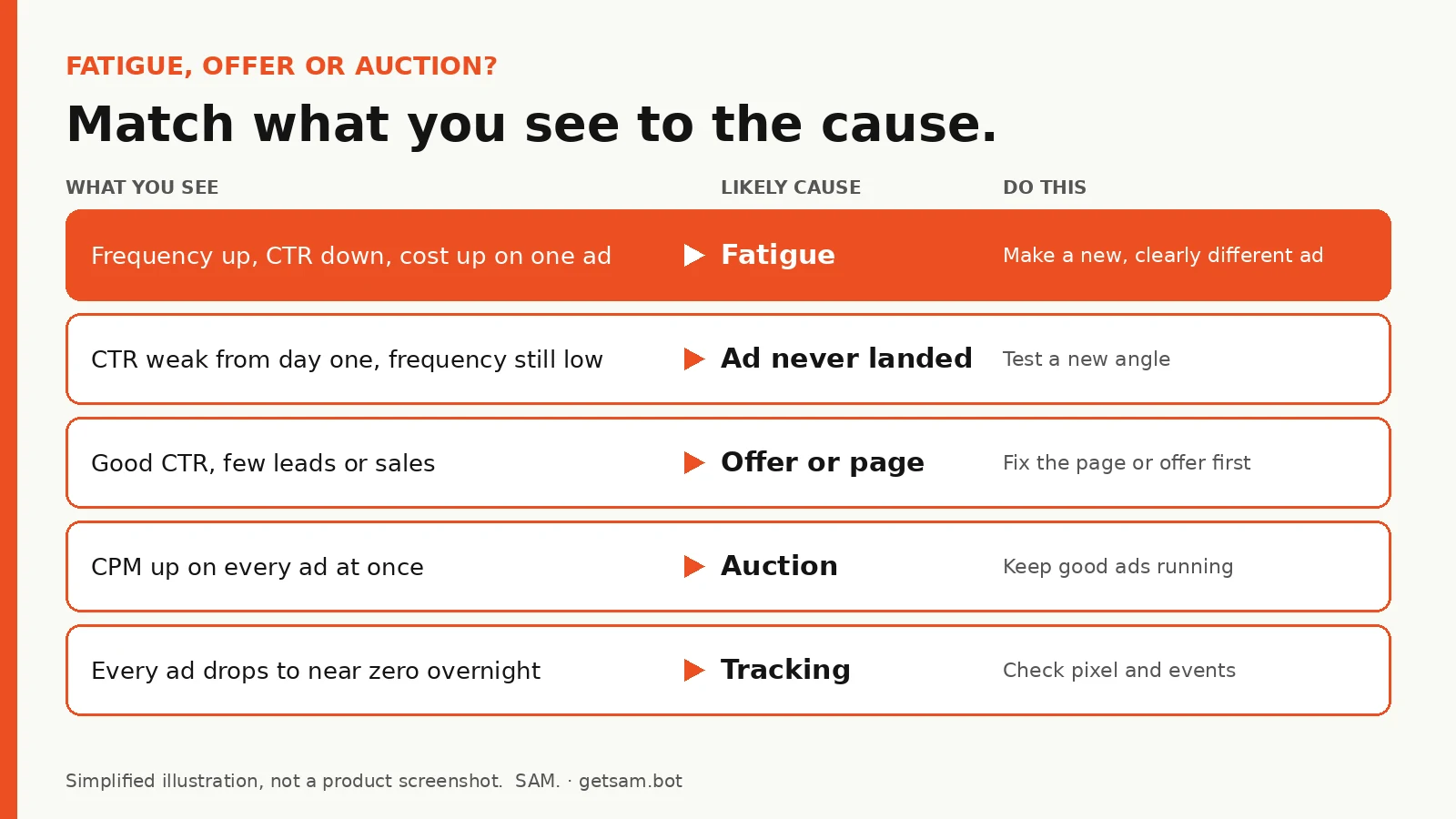
This is the decision that matters, because each cause has a different fix. Match what you see to a row.
| What you see | Likely cause | What to do |
|---|---|---|
| Frequency up, CTR down, cost per result up, on one ad that used to work | Fatigue | Make a new, clearly different ad |
| CTR was weak from the first few days and frequency is still low | The ad never worked | Kill it and test a new angle |
| CTR is fine, but clicks don't turn into leads or sales | The offer or the landing page | Fix the page or the offer before you touch the ad |
| CPM jumped on every ad at the same time | The auction (season, competition) | Don't kill good ads for it. Expect it around Black Friday |
| Results dropped to near zero on every ad overnight | Tracking | Check your pixel and conversion events first |
The third row is the one people miss. If people are clicking but not buying, the ad is doing its job. A fresh ad just sends more people to the same page that isn't converting. Look at the page and the offer. For sale season, the auction row matters too: Black Friday is Friday, Nov 27, 2026, and ad costs go up for everyone in that stretch. If you're planning that week, my Black Friday email examples post covers the email side, which doesn't get more expensive when ads do.
// 05A worked example (illustrative)
These numbers are made up to show how to read the pattern. They're not from a real account.
Say a home cleaning company runs one ad to a cold local audience: a before-and-after photo with the line "Your Saturday back." Here's the ad, week by week:
| Week | Frequency (cumulative) | CTR (link) | CPM | Cost per lead |
|---|---|---|---|---|
| 1 | 1.4 | 1.6% | $14 | $22 |
| 2 | 2.1 | 1.5% | $15 | $23 |
| 3 | 2.9 | 1.1% | $17 | $31 |
| 4 | 3.6 | 0.8% | $19 | $44 |
Weeks 1 and 2 are healthy. Frequency is rising, but CTR barely moves and cost per lead holds. In week 3 the crossing starts: frequency keeps climbing while CTR drops by about a quarter and cost per lead jumps. Week 4 confirms it. The cost per lead is now double week 1, which is the point where Meta would show "Creative fatigue" if this were the only ad in the ad set.
The other ads in the account kept a steady CPM, so it's not the auction. The landing page converted the same share of clicks in week 4 as in week 1, so it's not the page. That's fatigue. The right time to start a new ad was week 3, and most people wait until week 5.
// 06What to do when an ad is fatigued
Make a new ad that's materially different. That's Meta's own first recommendation, and the word "materially" is doing the work. Changing the button color or cropping the photo doesn't count, because the same people still recognize it. Change the concept: a new hook, a new angle on the problem, a new format (a short video instead of a photo), or a new person on screen. Need fresh videos fast? Here's how to make UGC video ads.
A few things that help:
- Keep the tired ad running while the new one ramps up, unless it's clearly losing money. Meta notes that keeping your original ad on instead of pausing it may get you more results.
- Change the first thing people see. If the old ad opened on the product, open the new one on the problem.
- Reach more new people. Meta also suggests widening the audience so the ad reaches people who haven't seen it much yet. This is the fix for a small retargeting audience that's been worn out.
- Write down what the old ad said and how long it lasted. That's your baseline for the next one.
My view on this hasn't changed: fresh creative beats fancy targeting. Meta's delivery system is good at finding buyers now. Your job is to keep giving it new ads worth showing. If you want a deeper look at what that looks like when AI does part of the work, I wrote about whether AI can actually run your Facebook ads.
// 07How many fresh creatives should you rotate?
Meta doesn't publish a number, and anyone who gives you one exact count for every account is guessing. The useful answer is to size it to your budget. Each new ad needs enough spend to reach a decision, so test only as many at once as your budget can judge within a week or two. A small daily budget split across ten new ads tells you nothing about any of them.
Then keep a pipeline. Don't wait for your best ad to die before you start making the next one. When an ad enters its healthy middle weeks, that's the time to have its replacement ready, because by the time Meta labels it, you've already paid for the slide.
// 08Where SAM fits
SAM is an AI marketing team built by the team behind SamCart: SAM + 5 AI specialists, and one of them handles ads. Going by SAM's own help docs and product notes, SAM reads your real numbers from the tools you connect and reports in plain English, and its Ad Account Audit playbook reviews your ads and suggests what to change. When it's time for fresh creative, the Ad Creative Pack playbook makes new ad images. SAM can also make UGC-style, testimonial, before-and-after and comparison ads, plus short videos for ads and Reels.
For Meta, SAM builds and launches campaigns, ad sets and ads in your own ad account. You approve before anything spends. SAM won't spend money on ads until you say yes. The playbooks above are examples; what's available is shown when you get access.
Want SAM to help keep your ads fresh?
SAM opens to a limited group first. 6 quick taps, about 60 seconds. Free. No credit card.
Let SAM score my marketing// 09Your one thing this week
Open Ads Manager, switch to the ad level, and break the last four weeks into weekly columns for frequency, CTR (link), CPM and cost per result. Find the one ad where frequency is rising and CTR is falling at the same time. Start its replacement today, with a different hook, before Meta tells you it's tired.
What frequency is too high for Facebook ads?+
There's no single number. Meta says frequency may average 1 to 2 per ad set or run much higher depending on budget, audience size and schedule. Watch your own trend: the frequency where CTR starts falling on your past winners is your warning line.
How long does a Facebook ad last before it fatigues?+
It depends on how fast you reach the same people again. A big budget on a small audience wears an ad out in days. A modest budget on a large audience can run for months. Check frequency and CTR weekly instead of picking a date.
Does turning an ad off and on again fix fatigue?+
No. The people who've seen it too often still remember it. Meta's recommendations are a materially different new ad, a wider audience, or Advantage+ creative variations.
Is ad fatigue the same as a bad ad?+
No. A fatigued ad worked and then wore out. A bad ad never worked. If CTR was weak from the first days and frequency is still low, the problem is the ad itself, so test a new angle.
Why did my CPM go up on every ad at once?+
That's usually the auction, not fatigue. Costs rise for everyone in busy seasons like the run-up to Black Friday. If CTR and conversion rate are holding, don't kill good ads because of it.
// FAQFacebook ad fatigue questions
// SRCSources
| Source | What it supports | Checked |
|---|---|---|
| Meta Business Help Center: Creative fatigue recommendations in Meta Ads Manager | Definition; Creative limited and Creative fatigue thresholds; one-creative ad set limit; recommendations (new materially different ad, expand audience, Advantage+ creative, keeping the original running) | Oct 13, 2026 |
| Meta Business Help Center: Frequency | Frequency definition; "may average 1 to 2 per ad set or may be much higher"; monitor frequency with results | Oct 13, 2026 |