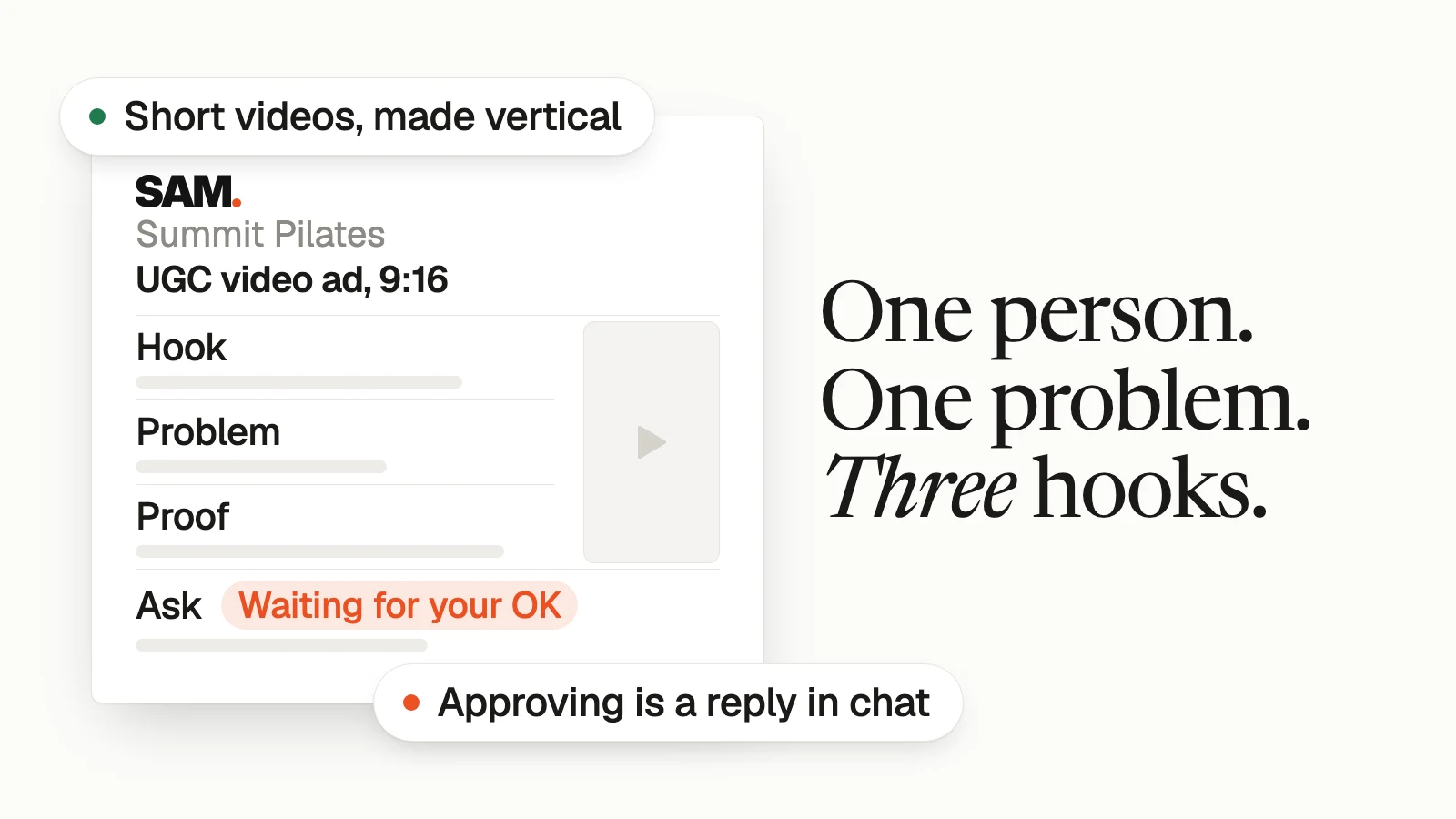
A UGC video ad is a short, phone-style video where a person talks straight to camera about a problem and how your product fixes it. It looks like a post from a regular person, not a commercial. To make one, write a 15 to 30 second script in four parts (hook, problem, proof, ask), film it vertical with captions, and make three versions of the first line so you can see which one stops the scroll.
UGC stands for user-generated content. The name started with real customers posting their own videos. Today most UGC ads are made on purpose for a business, by a customer, an employee, the owner, or someone you pay to film. Some are now made with an AI actor.
They work for one plain reason. People scroll past anything that looks like an ad, and they stop for anything that looks like a person talking to them. Here's how to make one, what to say in it, and where the honest line is when you use AI.
// 01What is a UGC video ad?
A UGC video ad is a paid ad on Facebook, Instagram, TikTok or YouTube Shorts that looks like a normal post: one person, a phone camera, natural light and their own words. You pay to show it to people who don't follow you.
| UGC-style video ad | Polished brand video | |
|---|---|---|
| Looks like | A person filming on their phone | A TV commercial |
| Who's on camera | A customer, the owner, a staff member, a hired person or an AI actor | Actors, a voiceover, product shots |
| Length | 15 to 30 seconds is plenty | Often longer |
| Cost to make | Low, so you can make several | High, so you usually make one |
| Best at | Getting a stranger to stop and listen | Looking premium |
Low cost matters for one reason: you can make five versions instead of one and let the numbers tell you which one people actually watch.
// 02Why UGC ads work for a small business
You don't need fancy targeting anymore. As I've put it before, "The truth is the Facebook algorithm is so smart now that you don't need targeting or fancy settings." That means the video itself does most of the work. The platform shows it to people, and the first two seconds decide whether they stay.
A person talking about a problem the viewer has is about the strongest opening there is. It feels like advice from a friend instead of a pitch. And because you can make these quickly, you can keep fresh ones coming when the old ones wear out. If you've watched an ad that used to work slowly stop working, that's Facebook ad fatigue, and new UGC versions are one of the easiest fixes.
// 03The four-part script: hook, problem, proof, ask
Almost every UGC ad that works follows the same shape. Write it out word for word, then let the person on camera say it in their own rhythm.
| Part | Time (30-second ad) | Job | Example line (illustrative, dog groomer) |
|---|---|---|---|
| Hook | 0 to 3 seconds | Make the right person stop | "If your dog shakes every time you pull into the groomer's lot, watch this." |
| Problem | 3 to 10 seconds | Say the frustration in the customer's words | "Loud dryers, cages, a two-hour wait. A lot of nervous dogs just can't handle it." |
| Proof | 10 to 25 seconds | Show how it works, or a real reason to believe | "We come to your driveway. One dog at a time, in a quiet van, done in about an hour." |
| Ask | 25 to 30 seconds | Tell them exactly what to do next | "Tap the link and pick a time this week." |
For a 15-second version, keep the hook and the ask, squeeze the problem into one sentence and show the proof instead of saying it.
Hooks that stop the scroll
The hook is the part to sweat. Write three to five and test them against each other. Here are patterns that work, with illustrative lines:
| Hook type | Example (illustrative) |
|---|---|
| Call out who it's for | "Bakery owners, this one's for you." |
| Name the pain | "I was spending every Sunday night writing posts nobody saw." |
| Show the result first | "This is what my front porch looks like after a pressure wash. Here's how." |
| Say the mistake | "Stop buying the cheap yoga mat. Here's why." |
| Ask a yes question | "Do your house plants keep dying even though you water them?" |
Make the first words match the first picture. If the hook says "look at this porch," the porch should be on screen.
// 04How to make a UGC video ad, step by step
Step 1: Pick one person and one problem
Write one sentence: who's watching, and what's bugging them. "A busy parent whose dog hates the groomer." Not "pet owners." One ad, one person, one problem. Your product might fix five things. Pick the one that hurts most.
Step 2: Write the script and three hooks
Use the four parts above. Keep it under 80 words for a 30-second ad, because people talk faster than they think on camera and you want room to breathe. Write three different hooks with the same body, so each version only changes the first line.
Step 3: Choose who's on camera
| Who | Good when | Watch out for |
|---|---|---|
| A real happy customer | You have someone who loves you and is comfortable on camera | Get written permission to use it as an ad, and let them say it their way |
| You, the owner | People buy from you because of you | Talk to one person, not "everyone out there" |
| A staff member | They know the product better than anyone | Same as above, get their OK in writing |
| Someone you pay to film | You want a person who looks like your buyer | Agree on where and how long you can run it before they film |
| An AI actor | You need several versions fast and nobody's free to film | Read the honest line section below first |
Step 4: Film it so it looks native
Vertical 9:16, phone at eye level, facing a window for light. Quiet room. Film each line two or three times. Get a few seconds of the product in use, because showing beats telling. Keep the most important words and anything you put on screen away from the very bottom and right edge, where the app's buttons sit.
Step 5: Edit tight and add captions
Cut every pause and false start. Most people watch with the sound off, so add captions, and put your key line on screen as text too. Open on the hook, not on a logo. End on the ask, said out loud and written on screen.
Step 6: Run the versions side by side
Put your three hook versions in the same ad set with the same budget and let them run for a few days before you judge them. Look first at how many people watch past the first three seconds. Then at clicks. Then at sales or sign-ups. Keep the winner, swap in a new hook against it and repeat. When you're ready to go further, here's whether AI can run your Facebook ads for you.
// 05A mobile dog groomer's first UGC ad (illustrative)
Here's how a small business could put this together in an afternoon. The business and every line are examples, not a real customer.
| Step | What they did |
|---|---|
| Person and problem | Parents of nervous dogs who dread the groomer's shop |
| Three hooks | "If your dog shakes in the groomer's parking lot, watch this." / "We groom dogs in your driveway. Here's why that matters." / "Nervous dog? Skip the shop." |
| Who's on camera | The owner, filmed in the van with a calm dog on the table |
| Proof shot | Five seconds of the quiet van and a relaxed dog |
| Ask | "Tap the link and pick a time this week." |
| Length and format | About 20 seconds, vertical, captions on |
| Test | Three versions, same budget, judged after a few days on watch time first |
// 06AI actors in UGC ads: the honest line
AI can now make a believable person talk to camera from a script. That's a real help for a small business that has nobody free to film. It also comes with a hard rule.
The FTC's rule on fake reviews and testimonials says a business can't create or spread a testimonial that misrepresents that the person exists, that they used the product, or what their experience was. A testimonial includes a video showing someone's likeness that people would take as a real customer's experience.
So an AI actor can explain what your product does, read your real facts, or act out the problem. An AI actor should never pretend to be a customer. Here's the difference in practice:
| OK for an AI actor (illustrative) | Not OK for an AI actor |
|---|---|
| "Here's how mobile grooming works." | "I tried this groomer and my dog finally relaxed." |
| "Three things to check before you book a groomer." | "Best groomer I've ever used, five stars." |
| Acting out a nervous dog owner's morning | A made-up name and city under the video, like a real review |
| Reading your real prices, hours or guarantee | Results nobody actually got |
If you want "I tried it" lines, use a real customer, in their own words, with their permission. The FTC's endorsement guides say the same thing from another angle: endorsements have to reflect the honest experience of the person giving them.
// 07Common UGC ad mistakes
| Mistake | Fix |
|---|---|
| Starting with "Hi, I'm..." or a logo | Start with the hook |
| Listing every feature | One problem, one fix |
| No captions | Captions on every version |
| Too polished | Phone, natural light, real room |
| Judging after one day | Give each version a few days and the same budget |
| Making one video | Make three hooks on day one |
| Fake testimonials | Real customers for "I" lines; AI actors only explain or act out |
// 08Where SAM fits (built by the founder of SamCart)
SAM is SAM + 5 AI specialists: Ads, Content, Designer, Promotions and Social. It's built by the founder of SamCart, and it takes the slow parts of UGC ads off your plate.
On setup, it learns your brand and offer from your website, and your customers and sales from the accounts you connect. Then you ask in plain words. SAM writes video ad scripts and makes short videos up to about 30 seconds, mostly vertical, ready for Reels, TikTok and Shorts. It can make UGC-style video ads with an AI actor from what you sell, your hook, the length and a script, and UGC-style image ads too. It shows you a cost heads-up before it makes a video.
Its UGC Video Ads playbook is one example of how this works. What's available is shown when you get access. With your Meta ad account connected, SAM builds and launches campaigns and reports on results, and it won't spend money on ads until you say yes. Approving is a reply in the chat, from your phone if you like.
SAM opens to a limited group first. Until it opens to you, let SAM score your marketing. It's free.
SAM isn't open to you yet. Let it score your marketing.
Let SAM score my marketing// FAQFAQ
What does UGC stand for in ads?+
User-generated content. It started as videos real customers posted on their own. Now it mostly means ads made to look like that: one person, a phone camera and their own words.
How long should a UGC video ad be?+
15 to 30 seconds is plenty for people who don't know you yet. Get the hook into the first three seconds, because that's where most people decide to stay or scroll.
Do I need to hire someone to make UGC ads?+
No. You can film yourself, a staff member or a happy customer on a phone. You can also use an AI actor to explain your product, as long as it never pretends to be a real customer.
Are AI UGC ads allowed?+
Using an AI actor to explain or demonstrate is fine. Using one to fake a customer testimonial isn't. The FTC's rule bans testimonials that misrepresent that the person exists or used the product.
How many versions of a UGC ad should I make?+
Start with three, each with a different hook and the same body. Run them side by side with the same budget, keep the winner and test a new hook against it.
// 09Your one thing this week
Write one sentence: who's watching and what's bugging them. Then write three hooks for it. Film the version you like best on your phone, vertical, with captions, and put all three hooks up against each other.
When you want a team that writes the scripts and makes the videos for you to approve, let SAM score your marketing.
// SRCSources
| Source | What it supports |
|---|---|
| 16 CFR 465.2, Fake or false consumer reviews, consumer testimonials, or celebrity testimonials (FTC) | A business can't create or spread a testimonial that misrepresents that the person exists, used the product, or what their experience was |
| 16 CFR 465.1, Definitions (FTC) | A consumer testimonial includes depictions of a person's likeness that people would take as a real customer's experience |
| 16 CFR 255.1, General considerations (FTC Endorsement Guides) | Endorsements must reflect the honest opinions, findings, beliefs or experience of the endorser |
| getsam.bot homepage | SAM + 5 AI specialists; free marketing audit; built by the founder of SamCart |