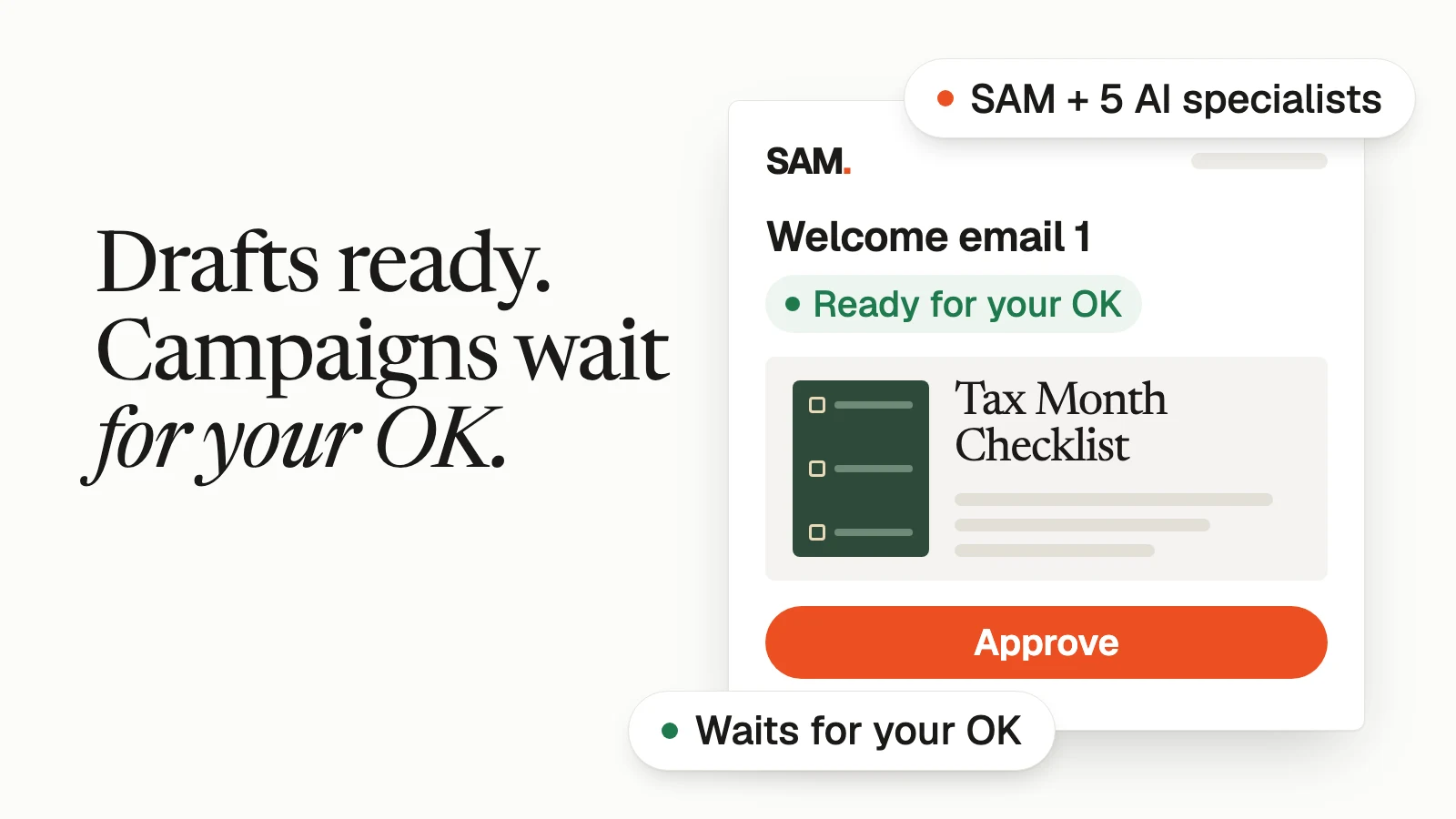
Use AI for marketing where it drafts, varies and audits fast, and keep the calls that decide what you sell, what goes live and what you spend. The mistake is treating a chatbot like a marketing team. The useful move is an approval-first workflow: AI does the heavy lifting, you say yes or no before anything hits your list, your ads or your site.
I've watched a lot of small businesses try both extremes. One side pastes a prompt, ships whatever comes back and wonders why the list unsubscribes. The other side refuses every tool, then burns nights writing the same five emails by hand. There's a middle path. This post covers the jobs AI does well today, the calls an owner should keep, a weekly workflow, a worked example, and how that maps to SAM + 5 AI specialists when you want a team that acts inside your tools after your OK.
// 01What AI is good at for marketing right now
AI is strong at starting from something real and producing options you can judge. It is weak at inventing your offer, your standards or your taste.
These jobs fit well today:
| Job | What AI should do | What you still decide |
|---|---|---|
| Drafts | First pass of emails, posts, ad copy, page copy, scripts | Whether the promise is true and on brand |
| Variations | Fresh angles, hooks and layouts from one approved idea | Which versions to test, and when to kill them |
| Audits | Pull numbers from connected ads, email and analytics and point out what changed | What to change in the account |
| Packaging | Turn one idea into a carousel, a short video script or a lead magnet outline | Whether that format is right for this offer |
| Recurring briefs | Morning or weekly summaries of what moved | Which actions are worth your time |
If AI only brainstorms a pile of vague ideas and you still have to invent the offer, it won't cut it. Write the offer yourself. What you sell and what you charge is your job. AI can help you say it more clearly and show up more often once the offer is clear.
// 02What you should never hand over
Keep these calls, even when the tools get better.
Your offer. Pricing, what's included, who it's for and who it's not for. AI can draft the page. It shouldn't invent the product.
Your yes before anything goes live. Emails to your list, posts to social, ads that spend money. If a tool can publish without asking, treat that as a bug in your process, not a feature.
Your spend. You approve before anything spends. Platforms bill ad spend to your card on that platform. The tool shouldn't move budget until you say yes.
Your proof. Real customer words, real results, real photos. Never invent testimonials or numbers. It's dishonest, and advertising rules punish it.
Your brand. Tone, claims you will and won't make, and the bar for "good enough to send." AI can match a voice you define. It can't invent one you respect.
A blunt rule I come back to: marketing beats product in most businesses, provided you care about your customers. That still means the marketing has to be true. AI that speeds up false claims just helps you fail faster.
// 03An approval-first workflow you can run this week
Here's a weekly loop that keeps AI useful without letting it run your business.
| Step | Owner | AI's job | Your job |
|---|---|---|---|
| 1. Pick one goal | You | None | Choose one outcome for the week (more leads, one email, one ad test) |
| 2. Feed real context | You | Read your site, offer and past winners you paste in | Give it your URL, one past email that worked, and the rule set |
| 3. Draft | AI | Produce the first version | Skim for truth and brand, not polish |
| 4. Revise once | AI | Edit what you flagged | Reply with specific edits, not "make it better" |
| 5. Approve | You | Wait | Say yes, change or kill before send, publish or spend |
| 6. Measure | Both | Pull the numbers from connected tools | Decide the next test from what actually moved |
Two habits make this work. First, give AI something real to start from (your site, a past winner, a clear brief), not a blank "write me marketing." Second, never skip step 5. If you're rubber-stamping everything, you're not approving. You're hoping.
// 04A worked example (illustrative)
This example is made up to show the workflow. It is not a real business's results.
A local bookkeeper wants more discovery calls from her email list of 1,200 past clients and referrals. Her goal for the week is one welcome-style nurture for new list signups from a free "Tax Month Checklist," plus two ad creative variations to test against her current Meta ad.
She pastes her website URL and last month's best email into her AI marketing setup. It drafts a four-email welcome outline and three ad hooks. She keeps two hooks, kills one that overclaims savings, and edits the welcome emails so email 3 tells her real story instead of a generic "why trust us" filler. She approves the first welcome email and one new ad. Nothing else goes out that day.
| Day | What ships | What waits |
|---|---|---|
| Mon | Checklist lead magnet page (she already had the PDF) | Ad spend on the new creative |
| Tue | Welcome email 1 after her OK | Emails 2 to 4 |
| Wed | New Meta ad creative, after she approves spend | The second hook |
| Thu | Welcome email 2 | Nothing unless open rates tank |
| Fri | Quick review of opens, clicks and cost per lead | Next week's one goal |
Notice what she didn't do. She didn't ask AI to invent a new service. She didn't let it send the whole sequence unattended. She didn't launch five ads at once. One goal, real context, drafts, one revise, then her yes.
If you need the email piece written out, my welcome email sequence post covers the four emails. If your Meta ads are getting stale rather than newly launched, Facebook ad fatigue walks through the numbers to check first.
// 05How to brief AI so the drafts are usable
Most bad AI marketing comes from a bad brief, not a bad model. Give it five things up front:
- Who you sell to, in one sentence.
- What you sell, and what you refuse to claim.
- One proof point you're allowed to use (a real story, a real number, a real process).
- The format and length (one email, seven carousel slides, two ad hooks).
- The approval rule: "Nothing goes live until I say yes."
Then ask for one deliverable. "Write my whole marketing plan" produces mush. "Draft email 1 of a welcome sequence that delivers the Tax Month Checklist and asks one reply question" produces something you can edit in five minutes.
When the draft comes back, edit for truth first. Cut anything you couldn't defend to a customer. Then edit for voice. Then approve or kill. That order matters. Pretty copy that overclaims is still a problem.
// 06Where SAM fits (built by the founder of SamCart)
SAM is SAM + 5 AI specialists (Ads, Content, Designer, Promotions and Social). It is built by the founder of SamCart. The point of the product is marketing that gets done inside your real tools, with you still holding the yes.
On setup, it learns your brand and offer from your website, and your customers and sales from the accounts you connect. From there it can draft emails, social posts, ad creative and pages, make the images and short videos a business owner needs, and run done-for-you playbooks that pause for your OK before anything that touches customers or spend. Playbooks are examples of whole jobs (Email Your List, Ad Creative Pack, Instagram Carousel, Lead Magnet Designer and others). What's available is shown when you get access.
That matches the workflow above. Drafts and variations move fast. Approvals stay with you. You approve before anything spends. SAM asks before it sends a campaign to your email list on connected tools like Kit, Mailchimp, MailerLite or ActiveCampaign, and before it publishes to Instagram, X or TikTok.
SAM does not replace your judgment, and it does not replace SamCart. SamCart is where you sell. SAM is where your marketing gets done. SAM opens to a limited group first. Until it opens to you, let SAM score your marketing. It's free.
If you're comparing tools, start with what an AI marketing agent is and the questions to ask before you connect one.
Want SAM to draft it and wait for your yes?
SAM opens to a limited group first. 6 quick taps, about 60 seconds. Free. No credit card.
Let SAM score my marketing// FAQFAQ
Is AI good enough to run my marketing without me?+
No. It can draft, vary and report. You still own the offer, the claims, the approvals and the spend. Tools that promise hands-free marketing are selling a fantasy that gets people in trouble with their lists and their ad accounts.
Should I use ChatGPT, or a marketing-specific tool?+
A general chat tool is fine for first drafts when you paste strong context. A marketing setup that connects to your real accounts is better when you want drafts grounded in your brand and numbers, and when publish and spend wait for your OK. Use whichever you will actually approve every time.
How do I keep AI on brand?+
Feed it your site, past winners and a short list of claims you will never make. Edit the first few outputs hard. Save the versions you approve and reuse them as examples. Brand is a pattern you enforce, not a vibe you hope for.
What should I automate first?+
Start with one recurring draft: a weekly email, a set of ad variations or a social carousel from one teaching idea. Put approval in front of send. Add the next job only after that loop feels boring in a good way.
Does using AI hurt SEO or trust?+
Search engines care whether the page is helpful, accurate and written for people. They do not ban AI-assisted writing. They do punish scaled low-value pages and false claims. Fact-check and don't publish filler to hit a quota.
// 07Your one thing this week
Pick one marketing job you already do by hand. Write a five-line brief, get one AI draft, edit it for truth, and put an approval step before it goes anywhere. Do that once this week. Then decide if the second job is worth adding.
When you want a team that drafts inside your tools and waits for your yes, let SAM score your marketing.
// SRCSources
| Source | What it supports |
|---|---|
| Google: Using generative AI content (updated Oct 1, 2026) | AI-assisted content is fine when accurate and helpful; mass low-value pages are spam |
| getsam.bot homepage | SAM + 5 AI specialists; free marketing audit; Nothing goes live without your yes; built by the founder / team behind SamCart |
| getsam.bot homepage FAQ and product copy (fetched for this package Oct 15, 2026) | Live claims used in the SAM section: learning line, images and short videos, playbooks with approval, email and social ask-first, spend approval |
| Brian Moran on X, Oct 8, 2026 | Write your offer yourself; AI does work, judgment stays yours |
| Brian Moran on X, May 27, 2026 | AI brainstorming vague ideas won't cut it; marketing beats product if you care about customers |