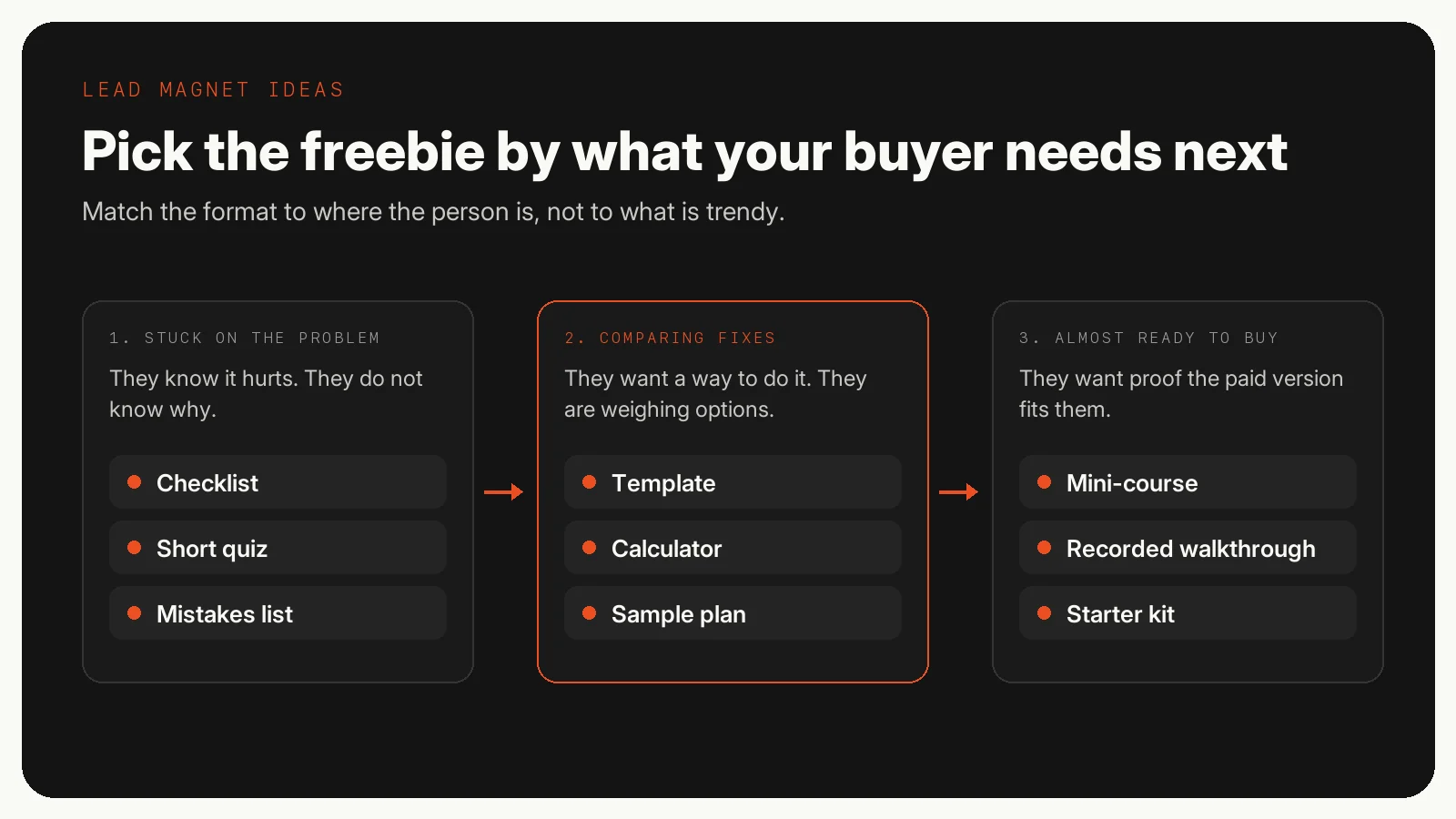
The best lead magnet solves one small problem that sits right before the thing you sell, and someone can use it in about ten minutes. To find yours, ask one question: what does a buyer have to believe, or have already done, right before they buy from you? Give them that for free, as a checklist, a template, a short plan or a walkthrough.
Most lead magnet lists hand you 50 formats and no way to pick one. The format matters a lot less than the fit. A gorgeous 40-page ebook that has nothing to do with your offer grows a list of people who'll never buy. A one-page checklist that fixes the exact problem your offer fixes next grows a list of people who are already halfway to yes.
// 01What is a lead magnet?
It's something useful you give away in exchange for an email address. The freebie is just the excuse. What you're really after is a conversation with someone who has the problem you solve, right when they're looking for help with it.
Every business that works has more than one thing to sell. Think of the lead magnet as the smallest one. It just happens to be free.
// 02What makes one worth signing up for?
Run the idea past four checks before you build anything.
It solves one problem you can name. "Grow your business" isn't a problem. "A month of client check-in emails, already written" is.
It's usable in about ten minutes. People sign up because they want a quick win today, not more homework.
It points at what you sell. The problem it fixes should be the step right before your paid offer, so the next question in their head is "ok, how do I do the rest?"
It shows up right away. If the download lands tomorrow, the moment's gone.
Most weak lead magnets fail the third check. They're useful... just not for anything the business actually sells.
// 0312 lead magnet ideas, sorted by what your buyer needs next
What someone will sign up for depends on where they are in their thinking. The table below splits 12 ideas across three stages. The example titles are illustrative. They show the shape of a good title, not real customer results.
| Where the buyer is | Idea | Example title |
|---|---|---|
| Stuck on the problem | Checklist | The 12-Point Product Page Checklist for Shopify Stores |
| Stuck on the problem | Short quiz | Which Pricing Mistake Is Costing You Clients? A 2-Minute Quiz |
| Stuck on the problem | Mistakes list | 7 Reasons Your Webinar Sign-Ups Don't Show Up |
| Stuck on the problem | Self-audit | Score Your Welcome Email in 5 Minutes |
| Comparing fixes | Template | A Discovery Call Script for New Coaching Clients |
| Comparing fixes | Worksheet or calculator | The Course Price Worksheet: Set a Price From Your Costs and Goals |
| Comparing fixes | Sample plan | A 4-Week Content Calendar for a One-Person Bakery |
| Comparing fixes | Swipe file | 10 Subject Lines for Winning Back Quiet Subscribers |
| Almost ready to buy | Email mini-course | 5 Days to Your First Paid Workshop |
| Almost ready to buy | Recorded walkthrough | Watch a Client Onboarding Folder Get Set Up in 12 Minutes |
| Almost ready to buy | Starter kit | The New-Puppy Starter Kit: Feeding Chart, Shopping List and First-Week Plan |
| Almost ready to buy | Free first chapter or lesson | Lesson One of the Watercolor Basics Course, Free |
If most of your visitors find you by searching for a problem, start with the first group. If they show up comparing tools or methods, use the second. If they already follow you and know what you sell, the third group is what helps them decide.
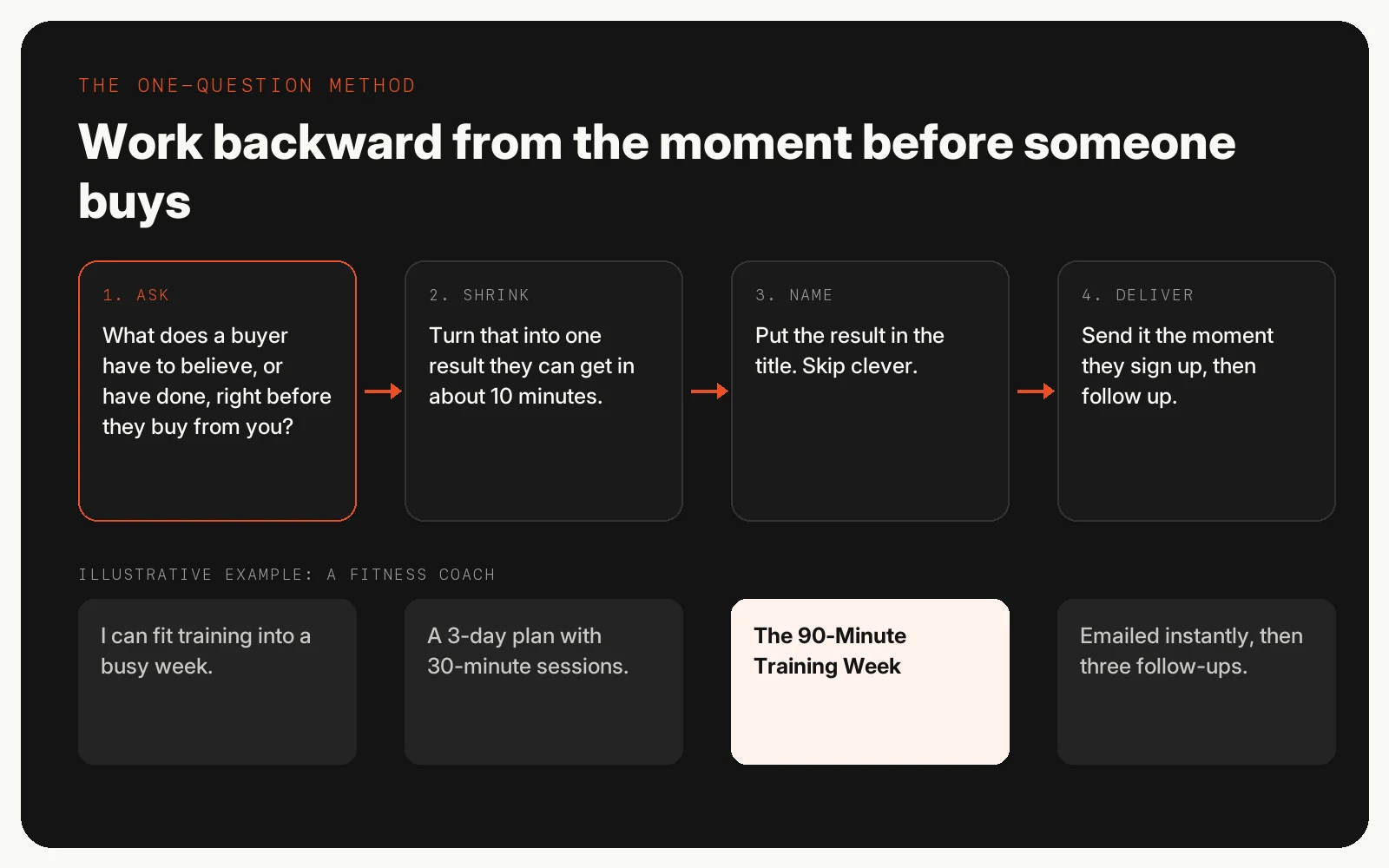
// 04How do you choose? Use the one-question method
You don't need a brainstorm. Having AI spit out a pile of ideas won't cut it either. What you need is one honest answer.
- Ask. What does a buyer have to believe, or have already done, right before they buy from you? Write it in one sentence.
- Shrink. Turn that sentence into one result someone can get in about ten minutes.
- Name it. Put the result in the title, in plain words.
- Deliver. Send it the moment they sign up, then follow up.
Take an illustrative example. A fitness coach sells a 12-week online program. Her best prospects hold back for one reason. They don't think they have the time. So the belief that comes right before buying is "I can fit training into a busy week." Her lead magnet is a three-day weekly plan with 30-minute sessions, called The 90-Minute Training Week. It goes out the moment someone signs up, followed by three short emails. Everyone who signs up wants to train but thinks they're too busy, and that's exactly who the 12-week program is for.
What she didn't make is a 30-page guide to nutrition, mindset and sleep. It would've looked more impressive. It also would've pulled in people hunting for free nutrition tips, and they aren't the people ready to buy a training program.
// 05How do you make it in an afternoon?
Write the title and a one-sentence promise first. If you can't, the idea's still too broad.
Then outline it on one page. A checklist is 8 to 15 items. A template comes with the structure already filled in. A plan has days and tasks.
Write it in your own words, with your own examples. The specific way you do this for clients is the whole reason it's worth an email address. Generic advice is free everywhere.
Keep it easy to skim and export it. Then open it on your phone before anyone else does, because plenty of people will read it there.
Last, build the sign-up page and the first email before you share it anywhere. A lead magnet with no follow-up is just a download.
// 06What goes on the sign-up page?
The page has one job, and that's getting the email address. Everything else on it competes with that job.
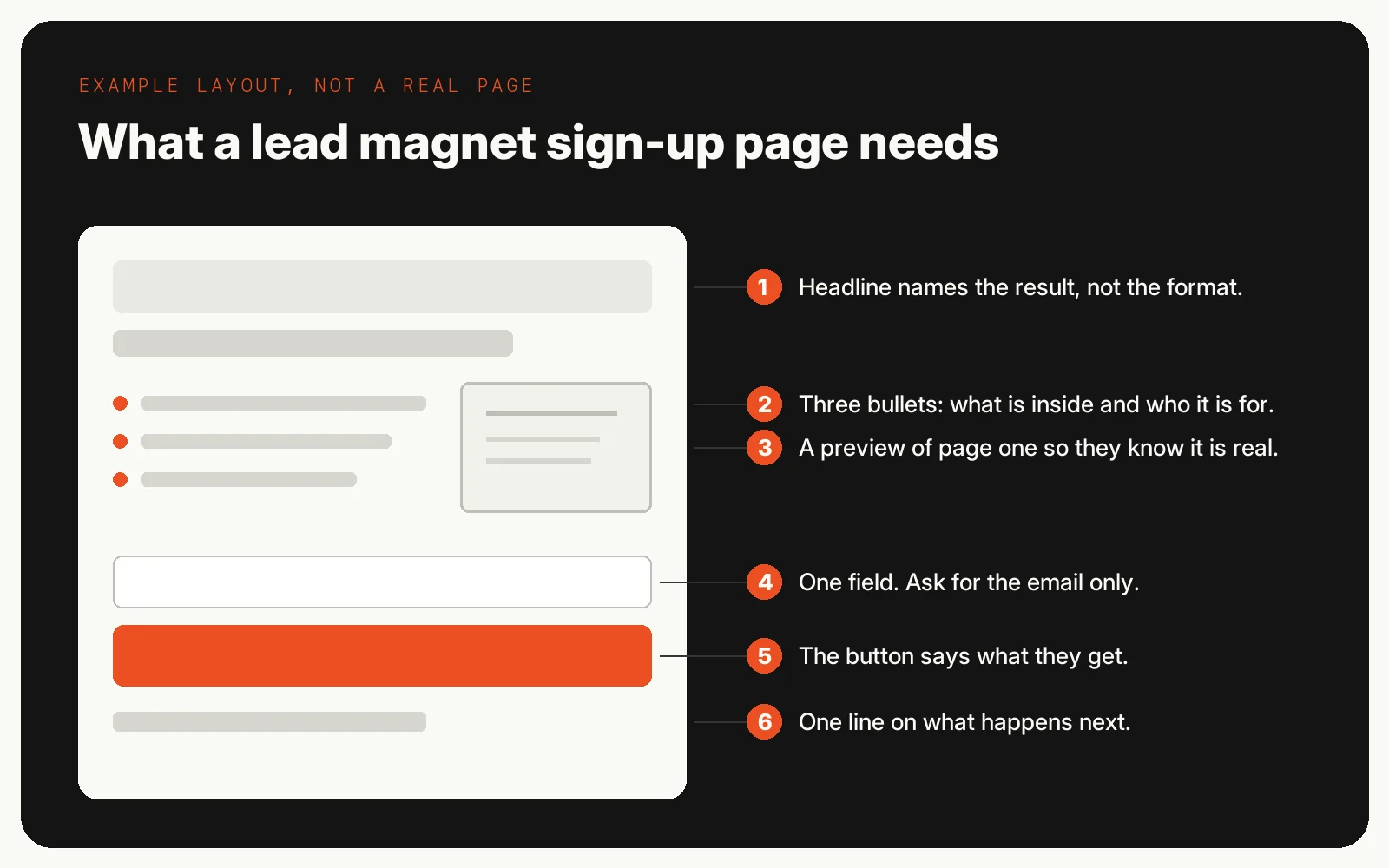
- A headline that names the result, not the format. "Plan a week of workouts in 90 minutes" beats "Free PDF download."
- Three bullets on what's inside and who it's for.
- A preview of page one, so people can see it's real.
- One field. Ask for the email address only, unless you'll genuinely use more.
- A button that says what they get, like "Send me the plan."
- One line on what happens next, like "It lands in your inbox in about a minute." Put your privacy policy link here too.
For the full page checklist, see landing page best practices.
// 07What happens after someone signs up?
Speed beats polish here. Someone who just signed up is thinking about your problem right now. Tomorrow they'll be thinking about something else. A plain note that lands in a minute does more than a beautiful one that lands next week.
So send your first email right away. Put the download link at the top, add one line on how to use it, and ask one question they can reply to. After that, a short follow-up does the rest.
- Right away. The download, how to use it, and one reply question.
- Day 2. The most common mistake people make with this problem, and how to avoid it.
- Day 4. An example of the next step working for someone like them, but only if it's real. If you don't have one yet, walk through the next step yourself.
- Day 6. An invitation to your paid offer, saying plainly who it's for and who it isn't for.
Keep every email short. Each one should be useful enough that the invitation feels like the obvious next step. Wearing people down won't get you there.
// 08Where do lead magnets usually go wrong?
It's too broad ("The Ultimate Guide to Marketing" helps nobody in particular). It's too long, so nobody opens it. It has nothing to do with the offer, like a free recipe book from a bookkeeper. Nobody follows up, so the list goes cold. The form asks for six things when it needed one. Or the page promises to double your sales, which pulls in the wrong people and costs you trust. Promise the result the magnet itself delivers, and nothing more.
If you plan to send paid traffic to the page, fix the magnet first. Then read whether AI can actually run your Facebook ads.
// 09How does SAM handle a lead magnet?
SAM is SAM + 5 AI specialists, an AI marketing team built by the founder of SamCart. That's me. The five specialists cover ads, design, content, promotions and social.
When you start, you add your website and connect your tools. SAM learns your brand and offer from your website, and your customers and sales from the accounts you connect. It connects to tools like Meta, Google, Mailchimp and WordPress, and it acts inside those tools.
Lead Magnet Designer is one of the example playbooks on SAM's site. You pick it from the Playbooks panel and hit Run Playbook. Playbooks are examples, and what's available to you is shown when you get access. Customer-facing playbooks wait for your approval, so nothing reaches your list until you approve it.
One thing I'd keep for yourself is the offer. What you sell and what you charge is your job, not the AI's. You pick the problem, the offer it points to, and when to invite people to buy.
Want SAM + 5 AI specialists on your marketing?
SAM opens to a limited group first. 6 quick taps, about 60 seconds. Free. No credit card.
Let SAM score my marketing// 10Your one thing this week
Write down one sentence. What does a buyer have to believe right before they buy from you? Then build the smallest free thing that gets them there. It's an afternoon of work.
Got a list and a sale coming? See the five emails to send for Black Friday.
Once people sign up, here's how to write the welcome email sequence that follows.
Once you have your freebie, here's how to set up your link-in-bio page so people can grab it.
// FAQLead magnet questions
How long should a lead magnet be?+
Long enough to solve one problem and short enough to use in about ten minutes. For most checklists and templates, that's one to five pages.
Do lead magnets still work?+
They work when they solve a specific problem that leads to what you sell, and when you follow up. A generic freebie with no follow-up rarely does much.
What's the best lead magnet for coaches?+
Usually a template or a short plan that gives people a small version of the result clients hire you for, like a session plan, a script or a one-week plan.
What's the difference between a lead magnet and a free trial?+
A lead magnet gives away one small piece of help for an email address. A free trial gives temporary access to the product itself.
Do I need an email tool?+
Yes, or a tool that sends email for you. Without one, you can't deliver the lead magnet automatically or follow up.