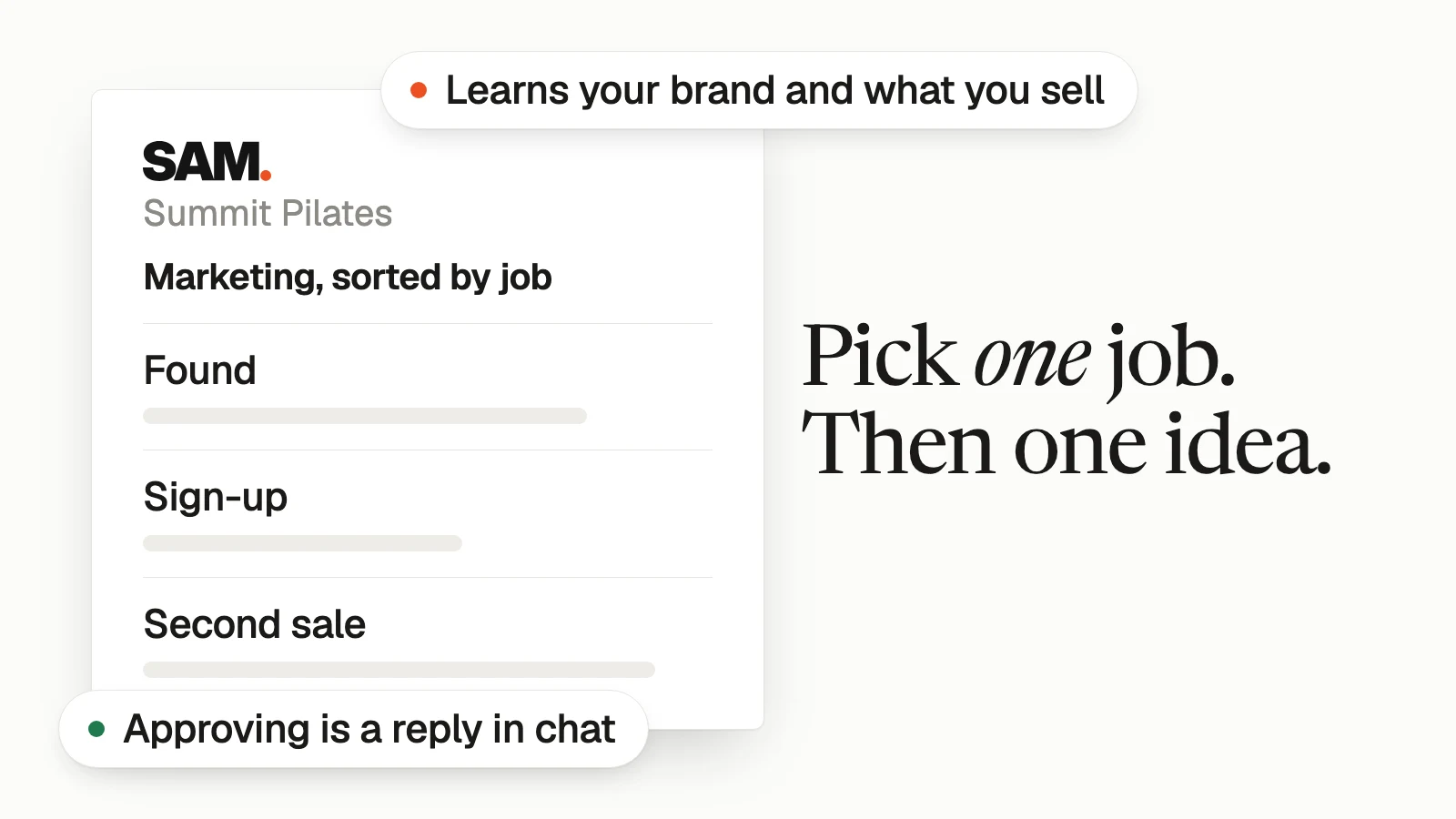
Every small business marketing idea does one of three jobs: it gets you found by new people, it gets someone to sign up so you can reach them again, or it gets a customer to buy a second time. Figure out which of those jobs is weakest in your business right now, pick one idea for it from the tables below, and do the first step this week.
Most lists of marketing ideas hand you 40 bullet points in no order. The ideas here are sorted by the job they do, and each one comes with its first step.
On Oct 9 I posted 25 reasons marketing doesn't bring in leads. Most of them break one of these jobs. "Form with too many fields" breaks the sign-up. "No follow-up email" breaks the second sale. A new idea on top of a broken job doesn't help, so find the broken one first.
// 01What are the three jobs a marketing idea can do?
Getting found, getting a sign-up and getting the second sale. Every idea you'll ever read about does one of those, and the one you need depends on where people are dropping off.
| Job | What it means | Start here if |
|---|---|---|
| Get found | Someone who's never heard of you finds you | Not enough new people are calling, visiting or landing on your site |
| Get a sign-up | Someone who found you gives you an email or phone number so you can reach them again | People check you out once and you never hear from them again |
| Get the second sale | Someone who bought once buys again or sends you a friend | Most customers buy one time and disappear |
Most small businesses are weak at one of these, not all three. If you'd like a quicker read on where yours stands, let SAM score your marketing.
// 02Ideas that get you found
Show up where your next customer is already looking. Pick one of these and give it a month before you judge it.
| Idea | First step this week | Best if |
|---|---|---|
| Fill in your Google Business Profile completely | Add your hours, services, service area and five recent photos of real work | People search for a business like yours nearby |
| Ask every happy customer for a review | Make a review link or QR code in your profile and send it the day the job's done | You have happy customers but only a handful of reviews |
| Answer the questions customers already ask | Write down the last five questions you got and turn one into a post this week | People research before they buy |
| Ask for referrals out loud | Ask your three happiest customers by name who else they know who needs this | Most of your business already comes from word of mouth |
| Team up with a business that serves the same customer | List three businesses your customers use right before or after you and email one owner | You share customers with someone you don't compete with |
Start with the Google profile if you serve a local area. Google's own help page says customers are 70% more likely to visit, and 50% more likely to consider buying from, a business with a complete profile.
For reviews, Google suggests a link or QR code and replying to the reviews you get. Don't offer a discount or freebie for a review, though. Google's policy prohibits it. Ask, don't pay.
Referrals are the most underused idea here. In Nielsen's 2021 survey of more than 40,000 people, 88% said they trust recommendations from people they know more than any other channel. Happy customers just don't think to recommend you until someone asks.
If social media is where your customers spend time, pick a schedule you can keep every week. My post on how often to post on Instagram covers the numbers.
// 03Ideas that get a sign-up
Give people a reason to hand you their email or phone number before they leave. Otherwise you have to find them all over again.
| Idea | First step this week | Best if |
|---|---|---|
| Give away one small, useful thing | Write one sentence: what does a buyer need right before they buy from you? | You get visitors but no way to follow up |
| One page with one job | Build a page with one headline, one field and one button | Your bio and profile links point at your homepage |
| Put that page behind every door you have | Add the link to your Google profile, bio, receipts and email signature | People find you in several places |
| Ask in person | Put a sign-up sheet or QR code at the counter with a reason to join, like early booking | Most of your sales happen face to face |
| Collect phone numbers for reminders | Ask for a mobile number for appointment or restock reminders | Your customers read texts faster than email |
The free thing is the part people get stuck on. My post on ideas for a free download people actually want covers how to pick one that points at what you sell, so I won't repeat it here.
Keep the form short, since "form with too many fields" made my list of 25. Ask for an email, and a phone number only if you'll use it.
Then make the first email arrive in minutes, not days. Here's the four emails to send new subscribers, starting with the one that goes out right away.
// 04Ideas that get the second sale
Go back to the people who already paid you. They've already decided you're worth it once.
| Idea | First step this week | Best if |
|---|---|---|
| Offer the next thing on purpose | Write down what a customer should buy after their first purchase | You sell one thing and stop |
| Talk to your last ten buyers | Call or message them and ask what else they wish you offered | You don't know what to sell next |
| Send a reminder when it's time to come back | Work out how often a typical customer rebuys and set a reminder for that day | Customers buy on a cycle, like seasons, refills or checkups |
| Email past customers every week | Pick one send day and put it on your calendar for the next month | You have a list you never use |
| Follow up the same day | Send every new inquiry or sign-up to a phone someone checks | Leads sit for days before anyone answers |
This is the job most small businesses skip. Research by Frederick Reichheld at Bain & Company found that keeping 5% more customers raised profits by 25% to 95% in the businesses he studied, because repeat customers buy more, cost less to serve and refer others.
As I put it on X a couple of weeks ago, repeat customers are everything. If you don't know what to offer them next, talk to them, then stop talking and take notes.
Your email list does the heavy lifting here. Businesses that grow always have their own list. When people tell me they've got a ton of people on social media, my question is always the same: where's your email list?
// 05A small cleaning business, sorted by job (illustrative)
This example is made up to show the method. It isn't a real business or real results.
A two-person house cleaning business gets most of its work from neighbors telling neighbors. The owner has about two hours a week for marketing. One-time deep cleans come in fine, but few of those customers book again, and there's no email list. So the weak jobs are the sign-up and the second sale.
| Job | Where it stands | Idea picked | First step |
|---|---|---|---|
| Get found | OK: steady word of mouth | Ask for referrals out loud | Add one line to the thank-you text: "Know a neighbor who'd want this? Here's our booking link." |
| Get a sign-up | Weak: no list at all | One page with one job | A page offering a free "spring cleaning checklist," linked from the Google profile and every invoice |
| Get the second sale | Weakest: one-time cleans don't rebook | Send a reminder when it's time to come back | A text and email six weeks after each deep clean, offering a regular every-other-week slot |
Notice what's not on the list: no new social account, no ads, no redesign. The weak jobs get the real work. After four weeks, the owner checks new sign-ups, rebooked customers and referrals.
// 06How is this different from a marketing plan?
A plan tells you which job matters most and how much time you'll give it. This post is the menu you pick from once you know. If you don't have a plan yet, my post on how to write a one-page marketing plan walks through the seven questions to answer first. Use the plan to pick the job, then come back here for the idea.
// 07What should you do this week?
Pick the option that fits the time you have.
| If you have | Do this |
|---|---|
| About an hour a week | Pick the one job that's weakest and do one idea from its table |
| Two or three hours a week | Pick one idea from each job and do just the first step of each |
Give it four weeks before you add anything new, and put one number on your calendar for the job you picked: new visitors for get found, sign-ups for get a sign-up, repeat orders for the second sale.
// 08Where SAM fits (built by the founder of SamCart)
SAM is SAM + 5 AI specialists: Ads, Content, Designer, Promotions and Social. It's built by the founder of SamCart, and it does the weekly work behind ideas like these, the part that usually stalls by week three.
On setup, it learns your brand and offer from your website, and your customers and sales from the accounts you connect. Then you ask in plain words. SAM writes emails, posts and page copy in your brand voice, and makes the images and short videos you need. It builds and publishes sign-up pages that collect leads, tags them by page and source, and sends them to your email list.
Two of its playbooks, Growth Plan and What Should We Do Next?, are made for the question this post starts with: what to work on next. Those are examples, and what's available is shown when you get access. Approving is a reply in the chat, from your phone if you like.
You decide what goes out. If you want help picking the job and doing the work, SAM opens to a limited group first. Until it opens to you, let SAM score your marketing. It's free.
// FAQFAQ
What's the best marketing idea for a small business with no budget?+
Ask for reviews and referrals. Both cost nothing but a few minutes, and they work because people trust recommendations from people they know more than any ad.
How many marketing ideas should I try at once?+
One per job at most, and one total if you only have an hour a week. Give each idea four weeks before you judge it or add another.
Which job should I work on first?+
The weakest one. If few new people find you, start with getting found. If people find you but leave, start with sign-ups. If customers buy once and vanish, start with the second sale.
What's the cheapest way to get repeat customers?+
Email the people who already bought. Send a reminder when it's time to come back, and offer the next thing they'd naturally need.
// 09Your one thing this week
Pick the one job that's weakest in your business right now, found, sign-up or second sale, and do the first step from its table before Friday. Write down the one number that tells you if it's working, and check it again in four weeks.
When you want a team that does the weekly work behind it, let SAM score your marketing.
// SRCSources
| Source | What it supports |
|---|---|
| Google Business Profile Help, "Complete your Business Profile on Google" | Customers are 70% more likely to visit and 50% more likely to consider purchasing from businesses with a complete profile |
| Google Business Profile Help, "Tips to get more reviews" | Remind customers with a link or QR code; reply to reviews; incentives for reviews are prohibited as fake and misleading content |
| Nielsen, "Beyond martech: building trust with consumers" (2021 Trust in Advertising study) | 88% of global respondents trust recommendations from people they know more than any other channel; survey of more than 40,000 consumers, September 2021 |
| Harvard Business Review, "The Value of Keeping the Right Customers" (Oct 29, 2014) | Frederick Reichheld of Bain & Company: increasing customer retention rates by 5% increases profits by 25% to 95% |
| Bain & Company, "Loyalty: A Prescription for Cutting Costs" | Why: return customers buy more over time, cost less to serve and refer others |
| Brian Moran on X, Oct 9, 2026 | The 25 reasons list: form with too many fields, no follow-up email, leads sent to an unchecked inbox, no weekly look at the numbers |
| Brian Moran on X, Oct 4, 2026 | "Repeat customers are everything"; talk to your buyers to find what to offer next (revenue figures in the post left out of the blog) |
| Brian Moran on X, Oct 7, 2026 | Businesses that grow always have their own email list; "a ton of people on social media" |
| getsam.bot homepage | SAM + 5 AI specialists; free marketing audit; built by the founder of SamCart |