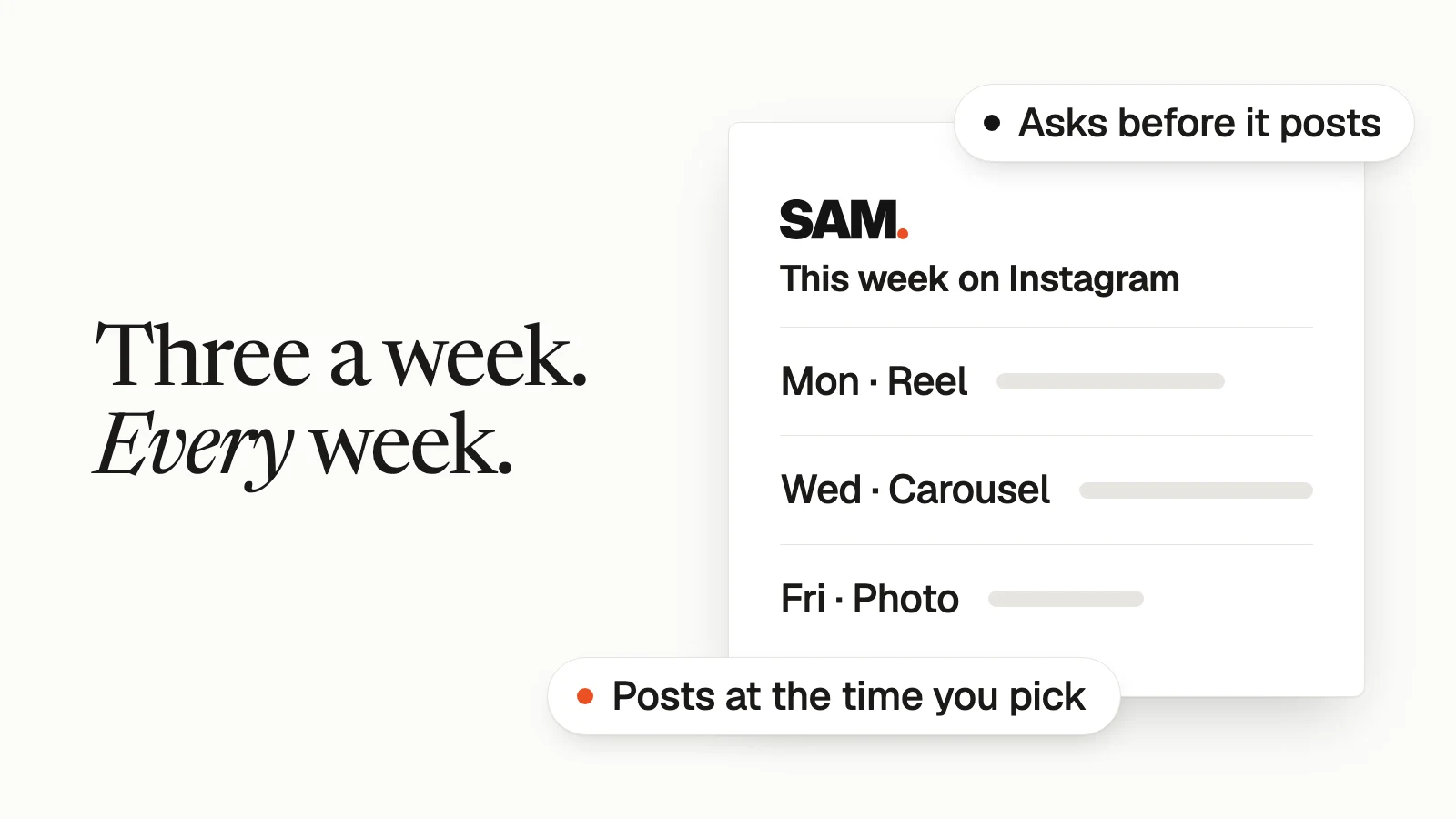
For most small businesses, three to five feed posts a week (Reels, carousels or photos) is the right target, plus a Story or two on the days you can. If that's more than you can keep up, post twice a week and don't miss a week, because a schedule you keep will beat a bigger one you drop by week three.
That answer comes from two places. Buffer looked at 2.1 million Instagram posts from about 102,000 accounts and found that three to five feed posts a week was the best trade between growth and effort. Adam Mosseri, who runs Instagram, has said there are "no magic rules," and the starting point he gave in a 2021 live Q&A was about two feed posts a week and two Stories a day.
So the number that matters is the one you can hit every single week, including the bad ones.
// 01How often should a small business post on Instagram?
Pick the level that matches what you want from Instagram over the next few months and the hours you really have.
| What you want | Feed posts a week | Pick this if |
|---|---|---|
| Stay visible | 1 to 2 | Most of your customers find you somewhere else, or you're in your busy season |
| Grow steadily | 3 to 5 | You want new followers and sign-ups from Instagram and can give it a few hours a week |
| Push hard | 6 or more | Instagram is your main way to find new customers and you can keep every post good |
The middle row is where most small businesses should start. In Buffer's study, weeks with three to five posts got about 12% more reach per post than weeks with one or two, and the follower growth rate more than doubled. Posting even more still helped, but each step up added less than the one before. Buffer compared each account against its own normal weeks, so this isn't just a case of big accounts posting more.
// 02What does Instagram say about how often to post?
Instagram gives a starting point and leaves the rest to you. In a live Q&A in June 2021, Mosseri said that posting consistently, about two feed posts a week and two Stories a day, helps build a following. In a 2023 Q&A he said there are "no magic rules here," and that he posts Stories a couple of times a day and to his feed a few times a week himself.
The data and Instagram agree on the shape: a few feed posts every week, Stories more often, and no plan that only works if you post ten times a day.
// 03How many Reels, carousels and Stories should you post?
Mix the formats by the job each one does. Buffer counted Reels, carousels and photos together as feed posts and left Stories out of its study, because Stories mostly reach people who already follow you.
| Format | Its job | A good weekly target |
|---|---|---|
| Reels (short vertical videos) | Show up in the Reels feed for people who don't follow you yet | 1 to 2 |
| Carousels (swipeable slides) | Teach one thing well enough that people save it | 1 |
| Photo posts | Show the work, the product or the people behind it | 1 to 2 |
| Stories | Stay in front of the people who already follow you | 1 or 2 on the days you can |
If your plan is three feed posts a week, a simple mix is one Reel, one carousel and one photo. My post on the 7-slide structure for a teaching carousel covers how to build the carousel.
// 04Is posting every day on Instagram too much?
Not for Instagram. Buffer found reach per post went up as accounts posted more, so extra posts didn't eat into each other. The limit is you. Buffer's data scientist, Julian Winternheimer, said the most important factor "probably remains content quality," and seven rushed posts a week won't do what three good ones do.
Move up a level only after you've kept your current schedule for four weeks straight. If you can't, drop back a level and keep that one.
// 05What happens if you skip a week?
Skipping costs more than posting a little. In Buffer's data, weeks with no posts grew followers slower than that same account's normal week, and even one or two posts beat none.
That means two posts every week will do better than five one week and nothing the next two. Plan for your worst week, not your best one. When you know a busy stretch is coming, make the posts ahead of time and schedule them. Instagram lets public accounts schedule photos, Reels and carousels from the app up to 30 days ahead.
// 06A weekly Instagram schedule you can keep (illustrative)
This example is made up to show the plan filled in. It isn't a real business or real results.
A two-chair hair salon wants more first-time bookings from people nearby. The owner can give Instagram about three hours a week, so they pick the middle row: three feed posts, plus Stories on the busy days.
| Day | Post | What it is |
|---|---|---|
| Monday | Reel | A 20-second before-and-after of one cut, with the name of the cut in the first line of the caption |
| Tuesday | Story | A poll asking which color the salon should show on Friday |
| Wednesday | Carousel | "5 questions to ask before you go blonde," with the last slide pointing to the link in the bio |
| Thursday | Story | Today's open appointment times, with a link sticker to book |
| Friday | Photo | A finished color, with a caption that says what it was and how long it took |
| Saturday | Story | A quick clip from the busiest hour of the day |
| Sunday | Nothing | Day off |
The owner takes photos and short clips while working, then spends one hour every Thursday after closing writing captions and scheduling the next week's three feed posts. Stories happen live on the day. That's the whole system, and it still works in a week when everything goes wrong, because the feed posts are already done.
// 07How do you make a week of posts without it eating your week?
Make the feed posts in one sitting, once a week, and schedule them. Here's the routine:
- Keep a running note of the questions customers ask you. Each question is a post.
- Block one hour on the same day every week. Pick three questions and the photos or clips you already took that week.
- Write the first line of each caption before anything else, and make it about the customer. "Headline about you" made my list of 25 reasons marketing doesn't get you leads, and on Instagram the first line is the headline.
- Schedule all three posts, then do Stories on the day when something's worth showing.
If a post doesn't get made in that hour, it doesn't go out that week. That's fine. Two good posts on schedule beat three you scramble for on Friday night.
// 08Where should your Instagram posts send people?
To your email list. Followers are great, but you don't own them, and you can't email them. Businesses that grow big always have their own list. I talk to a lot of people who tell me they've got a ton of people on social media, and my question is always the same: where's your email list?
Put one link in your bio, and point it at a page that gives away something free and useful in exchange for an email, like a price list, a checklist or a short guide. My post on ideas for a free download people actually want covers how to pick one, and the checklist for the page your posts send people to covers what goes on it. Then mention that link in at least one post a week, like the last slide of your carousel.
// 09Which numbers tell you it's working?
Check the same few numbers on the same day every week. "No weekly look at the numbers" was the last reason on my list, and "reporting on clicks, not leads" was right before it. Likes are nice. Sign-ups and customers pay the bills.
| Number | Where to find it | What it tells you |
|---|---|---|
| Accounts reached, followers vs non-followers | Instagram Insights | Whether your Reels are finding new people |
| Profile visits | Instagram Insights | Whether your posts make people curious |
| Taps on the link in your bio | Instagram Insights | Whether people want the free thing in your bio |
| New email sign-ups from Instagram | Your email tool or sign-up page | Whether Instagram is growing your list |
| New customers who came from Instagram | Asking "how did you hear about us?" | Whether it's paying off |
Give any schedule four weeks before you judge it, and compare it with your own last four weeks, not with someone else's account. Change one thing at a time so you can tell what made the difference.
// 10Where SAM fits (built by the founder of SamCart)
SAM is SAM + 5 AI specialists: Ads, Content, Designer, Promotions and Social. It's built by the founder of SamCart, and it's made for the weekly part of a schedule like this, the part that falls apart in a busy week.
On setup, it learns your brand and offer from your website, and your customers and sales from the accounts you connect. Then you ask in plain words. SAM writes social posts in your brand voice and makes the images and short videos you need. With Instagram connected, it publishes photos, Reels, Stories and carousels, and it asks first. You can preview a post before it goes out. Ask it to post at a set time and it schedules the post itself, and it plans your posts on your marketing calendar.
One of its playbooks is Instagram Carousel. That's an example, and what's available is shown when you get access. Approving is a reply in the chat, from your phone if you like.
Your part stays the same. You know what your customers ask, and you decide what goes out. If you want help keeping three good posts a week going, SAM opens to a limited group first. Until it opens to you, let SAM score your marketing. It's free.
// FAQFAQ
How often should I post Instagram Stories?+
One or two on the days you can. Mosseri's starting point was two a day. Stories mostly reach people who already follow you, so they keep you in front of regulars more than they find new people.
Is it better to post Reels or photos?+
Post both. Reels can show up in the Reels feed for people who don't follow you yet, and photos and carousels give your followers something to look at and save. Aim for at least one Reel a week.
Does posting too often hurt your reach?+
Not in Buffer's data. Reach per post went up as accounts posted more. What hurts is posts you rushed to hit a number.
Do I need to post on weekends?+
No. Pick the days you can keep. A schedule with weekends off that you hit every week beats daily posting you can't keep up.
What's the best time to post on Instagram?+
When your followers are on. Instagram shows suggested times based on when your followers are most active when you schedule a post, and your Insights show when your followers are online. Start there, keep the same times every week, and judge after four weeks.
How long before posting more shows results?+
Give a new schedule four weeks before you judge it. Look at reach, profile visits, link taps and email sign-ups against your own last four weeks.
// 11Your one thing this week
Pick your number, two, three or five feed posts a week, and put it on your calendar as fixed appointments for the next four weeks. Then block one hour before Monday and make next week's posts in one sitting.
When you want a team that keeps the posts going every week, let SAM score your marketing.
// SRCSources
| Source | What it supports |
|---|---|
| Buffer, "How Often Should You Post on Instagram in 2026?" (published Aug 13, 2025) | 2.1 million posts from 102K accounts; 3 to 5 feed posts a week as the best trade; about 12% more reach per post than 1 to 2; follower growth rate more than doubled; diminishing returns; weeks with no posts below the account's own baseline; Stories left out because they mostly reach followers; quality quote from Julian Winternheimer |
| Social Media Today, Mosseri live Q&A (June 10, 2021) | Two feed posts a week and two Stories a day to build a following |
| Business Insider, Mosseri AMA (March 24, 2023) | "No magic rules here"; he posts Stories a couple of times a day and to the feed a few times a week |
| Meta Help Center, scheduling posts and reels on Instagram | Public accounts can schedule photos, Reels and carousels from the app up to 30 days ahead; suggested times from follower activity |
| Brian Moran on X, Oct 9, 2026 | The 25 reasons list: headline about you, reporting on clicks not leads, no weekly look at the numbers |
| Brian Moran on X, Oct 7, 2026 | Businesses that grow always have their own email list; "a ton of people on social media" |
| getsam.bot homepage | SAM + 5 AI specialists; free marketing audit; built by the founder of SamCart |