A small business marketing plan should fit on one page and answer seven questions: who you sell to, what they buy first and next, what one customer is worth, where you'll show up, what happens after someone shows interest, what you'll spend, and which numbers you'll check every week. Write it for the next 90 days, not the next five years, and look at it every Monday.
Most plans I see go wrong in one of two ways. Either they're 30 pages nobody opens again, or they don't exist and the marketing is whatever felt urgent that morning. On Oct 9 I posted 25 reasons marketing doesn't bring in leads. Number two on the list was "audience of everyone." The last one was "no weekly look at the numbers." A one-page plan fixes both ends of that list, and you can write it in an afternoon.
// 01What should a small business marketing plan include?
Seven lines, and each one is a decision. If you can fill in this table, you have a plan.
| Line | The question it answers | A good answer sounds like |
|---|---|---|
| 1. Who | Who exactly are you selling to? | "Parents within 15 minutes of the shop who are planning a kid's birthday" |
| 2. First and next | What do they buy first, and what do you sell them after that? | "First a custom cake, then a cupcake box for the class party" |
| 3. Worth | What is one customer worth to you in a year? | A dollar figure, worked out with the math below |
| 4. Where | Which one or two places will you show up every week? | "Instagram three times a week and our email list every Thursday" |
| 5. Next step | What happens the minute someone shows interest? | "A free price list by email right away and a text from us the same day" |
| 6. Spend | What will you spend in money and in hours? | A monthly dollar amount and a set number of hours each week |
| 7. Numbers | Which numbers will you check every Monday? | "New sign-ups, new customers and where each one came from" |
The rest of this post walks through each line, then shows the whole table filled in for a made-up business.
// 02Who are you selling to?
One kind of customer, described so clearly you could pick them out of a room. "Small businesses" or "women 25 to 54" describes a crowd, and you can't write an ad, an email or a headline that speaks to a crowd.
Write one sentence that says who they are, where they are and the problem they'd pay you to solve this month. If you sell to three kinds of people, pick the one that brings in the most money and save the other two for the next 90 days.
One kind of customer doesn't mean a few big customers. I'd rather find a hundred people who'll pay me a hundred bucks than try to find one person who's going to pay me a thousand. A plan built on a steady stream of normal customers is easier to run and easier to fix than one that depends on landing a single big account.
// 03What will they buy first, and what comes next?
Write down the first thing a new customer buys from you and the thing you'll sell them after that. Plenty of plans stop at the first one. Nobody builds a real business on the back of one product.
The first purchase should be an easy yes. The next one is where the business grows, because repeat customers are everything. If you don't know what that second thing should be, talk to the people who already bought. Ask questions, then stop talking and take notes. Something will jump out at you.
Write this line yourself. What you sell and what you charge is your job, not the AI's. Once it's written, AI is good at suggesting add-ons and new things to sell around it, but it shouldn't be picking your price.
// 04What is one customer worth?
Do this math before you decide what to spend, because it tells you what you can afford to pay to win a new customer.
| Step | How to work it out |
|---|---|
| Average sale | Your total sales for the last 90 days, divided by the number of orders |
| Purchases per year | How many times a typical customer buys from you in 12 months |
| Yearly sales per customer | Average sale times purchases per year |
| Profit per customer | Yearly sales per customer times your margin, which is what's left after the cost of making or delivering what you sold |
The last row is the most one new customer can be worth to you in a year. You don't want to spend all of it to win them, but now you know whether $15 to get a customer is cheap or way too much. If you've never tracked these numbers, write down your best guess and correct it after 90 days.
// 05Where will you show up?
Pick one or two places and show up there every week. Two places done every week will beat five places you get to once a month.
For ideas sorted by the job they do, see small business marketing ideas.
Choose by where your one customer already spends time and what you can keep up during a busy week. Use this as a rough guide:
| If your customer | Start with | Why |
|---|---|---|
| Searches for a business like yours nearby | Your Google Business Profile, with fresh photos and replies to every review | They're already looking, so you need to be the one they find |
| Scrolls Instagram or Facebook | Posts three times a week, and ads when you're ready to spend | They see you before they need you |
| Already bought from you | Your email list, every week | You own the list, and it's where the second sale happens |
| Buys for another business | LinkedIn and direct emails | Those decisions happen person to person |
Whatever else you choose, build your own email list. Businesses that make it big always have one. I talk to a ton of people who tell me they've got a big following on social media, and my first question is where their email list is. You don't need paid ads to get started either. Plenty of businesses grow a long way with no ads at all.
// 06What happens after someone shows interest?
This is the line most plans leave blank, and it's where a lot of leads get lost. Three of my 25 reasons are right here: no follow-up email, follow-up days late, and leads sent to an inbox nobody checks.
Write down the steps from "interested" to "customer." For most small businesses it looks like this:
- Something free and useful in exchange for an email, like a price list, a short guide or a checklist. My post on ideas for a free download people actually want covers how to pick one.
- One page with one job, collecting that email. The checklist for the page your ads and emails send people to covers what goes on it.
- A welcome email right away and a few more over the next week or two. Here's what to put in a welcome email sequence.
- A real person following up the same day, or at least an alert to a phone someone checks.
If you can't say who does step four and how fast, fix that before you spend anything on step one.
// 07How much should a small business spend on marketing?
No single percentage fits every business, so work from the customer math instead. Decide how much of one customer's yearly profit you're willing to spend to win them, then set a monthly amount you can keep up for the full 90 days.
Budget your hours too. If you have no money for ads, your budget is time, and three steady hours every week will do more than 20 hours in week one and nothing after.
If you do run ads, start small and keep them fresh. When I wrote out how I'd start a local service business from scratch, I said start with $50 a day and keep your ads fresh. If that's more than your plan can carry, start lower. New ads every week or two will teach you more than a bigger budget behind the same ad for months, and my post on how to tell when your Facebook ads are worn out shows what to watch. Two more mistakes from my list belong here: changing ads every day, and quitting before the test ends. Pick a test length before you start and stick to it.
// 08Which numbers should you check every week?
Leads and customers, not clicks and likes. "Reporting on clicks, not leads" made my list because clicks are easy to get and don't tell you whether anyone bought.
| Number | Where to find it | If it drops |
|---|---|---|
| New leads: emails, calls and form sign-ups | Your email tool or sign-up form | Check the page and where the visitors came from |
| New customers | Your store or sales records | Check the follow-up step |
| Where each lead came from | Your sign-up form, your store, or asking "how did you hear about us?" | Put more time into the place that's working |
| Repeat purchases | Your store or sales records | Email past customers about the next thing to buy |
| Money and hours spent | Your ad account and your calendar | Cut what isn't bringing in leads |
Put 20 minutes on your calendar every Monday and write these five numbers in the same spreadsheet each week. After four weeks you'll start to see which way things are moving. After 12 you'll know what to keep for the next plan.
// 09A worked example (illustrative)
This example is made up to show the template filled in. It isn't a real business or real results.
A neighborhood bakery that also takes custom cake orders wants more cake orders this fall. Here's its one-page plan for the next 90 days.
| Line | The bakery's answer |
|---|---|
| Who | Parents within 15 minutes of the shop who are planning a kid's birthday |
| First and next | First a custom birthday cake, then a cupcake box for the class party and a monthly treat box |
| Worth | A $60 cake twice a year plus one $30 cupcake box is about $150 a year in sales per family. At a 50% margin, that's about $75 of profit per family |
| Where | Google Business Profile with new cake photos every week, Instagram three times a week, and the email list every Thursday |
| Next step | A free "birthday cake price list and order deadlines" PDF on a one-page sign-up form, a welcome email right away, and a text from the owner the same day to anyone who asks about a date |
| Spend | $15 a day on local Instagram ads pointing to the sign-up page, plus 3 hours a week for photos and posts |
| Numbers | Every Monday: new sign-ups, cake orders, where each order came from, repeat orders and ad spend |
Look at what the "Worth" line does. With about $75 of profit per family, the owner knows that winning a new family for $25 is a good trade and $100 isn't. That one number shapes every ad decision for the next 90 days, and it took ten minutes to work out.
// 10Where SAM fits (built by the founder of SamCart)
SAM is SAM + 5 AI specialists: Ads, Content, Designer, Promotions and Social. It's built by the founder of SamCart, and it does the weekly work a plan like this asks for, so the plan doesn't stall in week three.
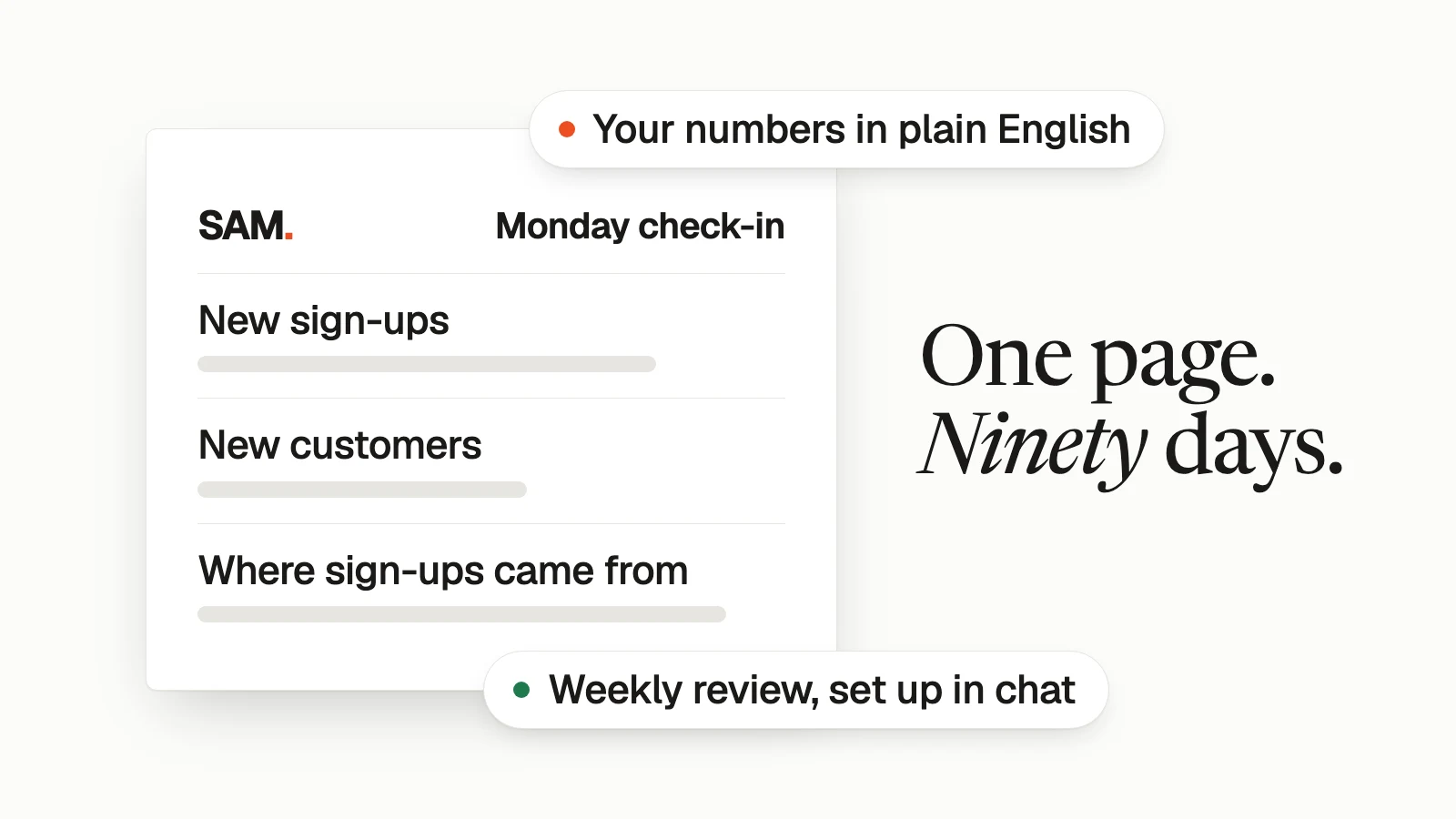
On setup, it learns your brand and offer from your website, and your customers and sales from the accounts you connect. From there you ask in plain words. SAM writes emails and posts in your brand voice, makes the images and short videos you need, and builds and publishes sign-up pages that collect leads and send them to your email list. It plans posts on your marketing calendar. Describe a recurring job in chat, like a review of your numbers every Monday, and SAM sets it up. It reads your real numbers from the tools you connect and reports them in plain English.
Its playbooks include Growth Plan, What Should We Do Next?, Morning Briefing and Weekly Business Review. Those are examples, and what's available is shown when you get access. SAM won't spend money on ads until you say yes, and approving is a reply in the chat, from your phone if you like.
The first two lines of the plan stay yours. Who you sell to and what you sell them is your call. If you want a team for the rest, SAM opens to a limited group first. Until it opens to you, let SAM score your marketing. It's free.
Want a team that does the weekly work in your plan?
SAM opens to a limited group first. 6 quick taps, about 60 seconds. Free. No credit card.
Let SAM score my marketing// FAQFAQ
How long should a small business marketing plan be?+
One page. If it runs longer, you've probably written down tasks instead of decisions. Keep the working detail, like post ideas, ad drafts and email drafts, in a separate doc.
How often should I update my marketing plan?+
Check the numbers every week and rewrite the plan every 90 days. Between rewrites, change one line at a time so you can tell what made the difference.
What's the difference between a marketing plan and a business plan?+
A business plan covers the whole company: what it sells, how it makes money, who runs it and what it needs. A marketing plan covers one part of that, which is how you'll find customers and keep them buying over the next stretch of time.
Do I need a marketing plan if I run the business alone?+
Yes, and it matters more, because your hours are the budget. A one-page plan stops you from spending Tuesday on a place you already decided to drop.
Is there a free marketing plan template?+
The seven-line table near the top of this post is the template. Copy it into a doc or spreadsheet, write one answer per line, and print it.
// 11Your one thing this week
Block one hour this week and fill in the seven lines for the next 90 days, even if the "Worth" line is a guess. Then put 20 minutes on your calendar every Monday to check the numbers.
When you want a team that does the weekly work in your plan, let SAM score your marketing.
// SRCSources
| Source | What it supports |
|---|---|
| Brian Moran on X, Oct 9, 2026 | The 25 reasons list: audience of everyone, no follow-up email, follow-up days late, leads sent to an unchecked inbox, ads changed every day, quitting before the test ends, reporting on clicks instead of leads, no weekly look at the numbers |
| Brian Moran on X, Oct 7, 2026 | Nobody gets there on one product; you don't need paid ads to grow; growing businesses have their own email list; a hundred people at a hundred bucks over one at a thousand |
| Brian Moran on X, Oct 4, 2026 | Repeat customers are everything; talk to your buyers to find the next thing to sell |
| Brian Moran on X, Oct 8, 2026 | What you sell and what you charge is your job, not the AI's |
| Brian Moran on X, Oct 8, 2026 | Start ads at $50 a day and keep them fresh |
| getsam.bot homepage | SAM + 5 AI specialists; free marketing audit; built by the founder of SamCart |