UGC stands for user-generated content. It's the photos, videos, reviews and posts about your business that your customers make, not you. For a small business it's the most believable marketing you have, because it's real people showing your product in real life. You can collect it for free, reuse it with permission, or pay people to film UGC-style videos for your ads, as long as you're honest about who made it.
That's the short version. Below is what counts as UGC, the difference between free, paid and AI-made UGC, how to get your customers to make it, where to use it, and the two FTC rules every owner should know before posting it.
// 01What does UGC mean?
UGC is any content about your business that someone other than your business made. A customer's photo of your cake at their kid's party is UGC. So is a 5-star review, a TikTok of someone opening your box, or a post where a client tags you.
Content you make yourself, like your own product photos or your own ads, is brand content. The difference matters because buyers trust other buyers more than they trust you talking about yourself. When a stranger shows your product working, it reads as proof, not a pitch.
In marketing, you'll also hear "UGC" used for a newer thing: short, phone-style videos that a business pays someone to film so they look like customer videos. More on that below, because the rules are different.
// 02Types of UGC
Most UGC falls into six kinds. You probably already have some of these and aren't using them.
- Reviews and star ratings. On Google, Facebook, Yelp or your own site.
- Customer photos. Your product in their kitchen, their yard, their gym bag.
- Customer videos. Unboxing, first use, before and after, a quick "here's why I like it."
- Tagged posts and Stories. Anything where a customer tags your account or uses your hashtag.
- Testimonials. A quote you collected by email, text or a short form, used with permission.
- Comments and questions. The real words customers use, which are great for your next post or ad.
// 03Organic UGC vs paid UGC vs AI UGC
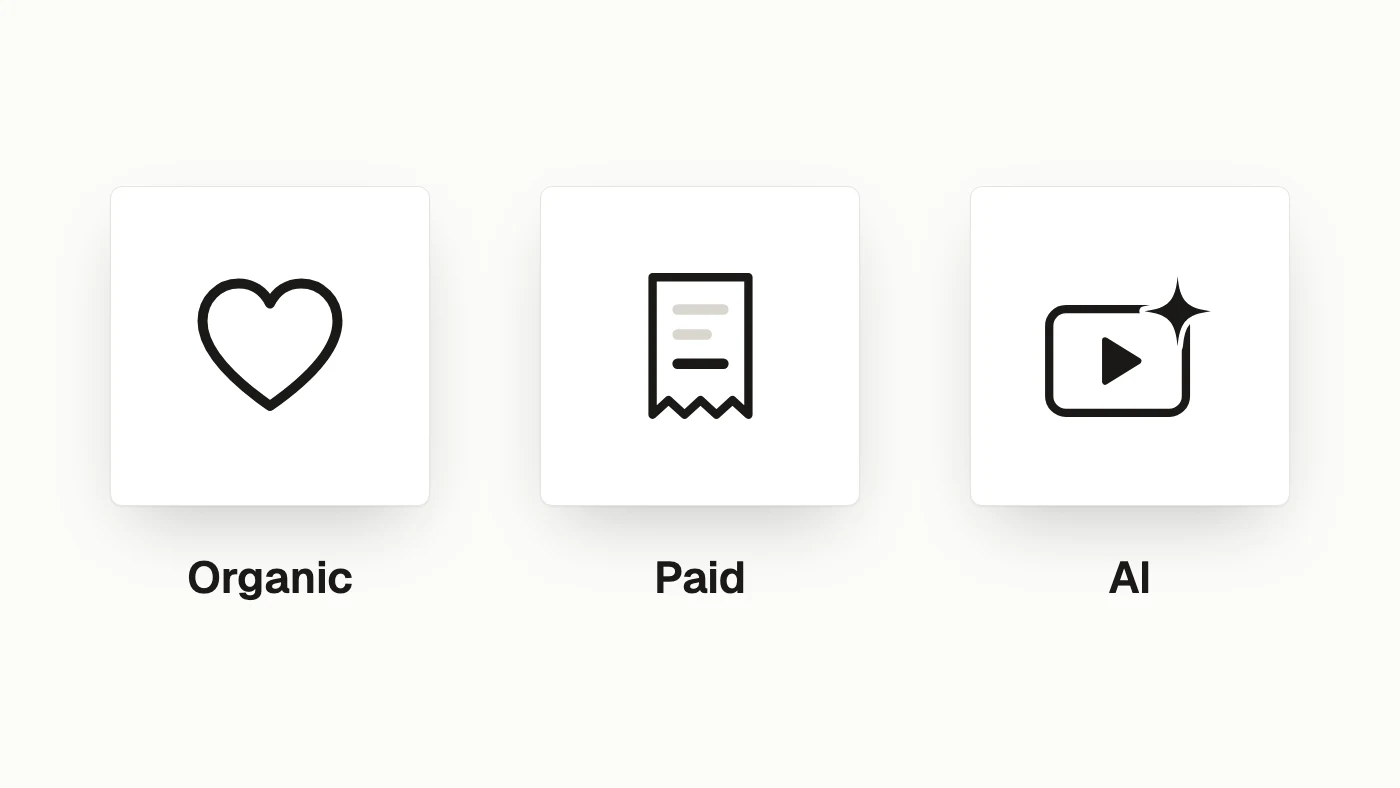
There are three kinds of "UGC" people mean today, and only one of them is made by actual customers.
| Organic UGC | Paid UGC | AI UGC | |
|---|---|---|---|
| Who makes it | Real customers, on their own | A person you hire to film it | An AI actor in a generated video |
| What it costs | Free | You pay per video | Your tool's cost |
| What you need first | Their permission to reuse it | A clear agreement on use | Nothing from a customer |
| Can you call it a customer review? | Yes, if it is one | Only if they really bought and used it, and you disclose the payment | No |
Organic UGC is the most trusted, but you can't control when it shows up. Paid UGC gives you control over the script and look. AI UGC is the fastest way to test a lot of ad ideas, but it's an ad, not a customer, so never present it as one.
If you want to make UGC-style video ads, here's how to make a UGC video ad, including the honest line on AI actors.
// 04Why UGC works for a small business
UGC works because it shows your product through a buyer's eyes, and that's the thing your own ads can't do.
- It looks real. A phone video in someone's living room feels like a friend's post, not a commercial.
- It answers the buyer's real question. "Will this work for someone like me?" is easier to answer when someone like them is in the picture.
- It fills your feed. Every customer photo is a post you didn't have to make.
- It works in ads. Many of the ad formats owners copy, like testimonial and before-and-after ads, are built around customer content. Here are 8 Facebook ad formats to copy, with UGC-style ads in the mix.
None of this needs a big following. One good customer video can carry your ads for weeks.
// 05How to get UGC from your customers
Ask at the happy moment, make it one easy step, and always ask before you reuse it. Here's a simple way to do it:
- Pick the happy moment. The day the order arrives, the end of a good appointment, the week they hit a result. That's when people say yes.
- Ask one easy question. "Would you send us a photo of it in your home?" beats "Please leave us a detailed review."
- Give them a place to put it. A link to your Google review page, a reply-to email, or your account to tag.
- Show it off. Repost it, thank them by name if they're OK with that, and reply to every review. People share more when they see others get featured.
- Get permission in writing before you reuse it. A tagged post is not a yes to use it in an ad. A quick message like "Can we share this on our page and in our ads? We'll credit you." and a reply of "yes" is your record.
- Keep a folder. Save every photo, video and review in one place with the date and the permission message, so you can find it when you need an ad.
// 06How to use UGC in your marketing
Put UGC where buyers are deciding: your posts, your ads, your sales page and your emails.
- Social posts. Repost a customer photo with their words as the caption, or turn a short review into a quote post.
- Ads. Use a customer video as the ad itself, or a review as the headline over a product photo.
- Your sales page. Put two or three real reviews right next to the buy button, where the doubt is.
- Emails. Open with one customer's story in their words, then make your offer.
Use one customer per piece. One real person with a clear result is stronger than a wall of logos and stars.
// 07The rules: permission, payment and fake reviews
Two FTC rules matter here: disclose when you paid or gave something for a post, and never fake a review. This isn't legal advice, but these are the lines to know.
- Disclose material connections. The FTC's Endorsement Guides say that if you paid someone, gave them a free or discounted product, or there's a business, family or personal tie the audience wouldn't expect, that connection has to be disclosed clearly (16 CFR 255.5).
- No fake reviews or testimonials. The FTC's Consumer Review Rule, in effect since Oct 21, 2024, bans businesses from writing, buying or selling reviews or testimonials that misrepresent that the reviewer exists, that they used the product, or what their experience was (16 CFR Part 465).
So paid UGC needs a disclosure like "paid partnership" or "#ad," and AI UGC can never be passed off as a real customer saying real things. Both rules were checked on the government's own pages on Nov 25, 2026.
// 08A simple UGC week (illustrative)
Here's what one week of using UGC could look like for a small home cleaning business. This is a made-up example, not a real customer.
- Monday. Text the last 10 happy clients: "Would you send a quick photo of your kitchen after today's clean?"
- Tuesday. Two photos come back. Reply asking if you can share them on your page and in ads, with credit.
- Wednesday. Post the best one with the client's own words as the caption.
- Thursday. Turn a 5-star Google review into a quote post.
- Friday. Use the second photo in a small local ad, with the review line as the headline.
No new photo shoot, no actors, and every piece is real.
// 09Where SAM fits (built by the founder of SamCart)
SAM helps you turn the UGC you have into posts and ads, and make UGC-style ads when you don't have any yet.
SAM is the AI marketing team built by the founder of SamCart, and it learns your brand and offer from your website, and your customers and sales from the accounts you connect.
It makes quote posts and Instagram carousels, so a real customer review you share with it can become this week's post. It also makes UGC-style image ads and testimonial ads. With the UGC Video Ads playbook, it makes UGC-style video ads with an AI actor, from your offer, hook, length and script. Those are ads made with an AI actor, not customer reviews, so treat them that way.
Playbooks that reach customers pause for your OK before anything goes out. You decide what's real, what gets posted and what runs. Nothing here is a promise of results.
SAM isn't open to you yet. Let it score your marketing.
Let SAM score my marketing// FAQFAQ
What does UGC stand for?
UGC stands for user-generated content. It's any photo, video, review or post about a business that was made by customers or fans instead of the business itself.
Is UGC free?
Organic UGC from your customers is free, but you should get their permission before you reuse it. Paid UGC costs whatever you pay the person who films it, and AI UGC costs whatever your tool costs.
Do I need permission to repost customer content?
Yes. A tag or a mention isn't permission to use someone's photo or video in your ads. Ask in writing, save their reply, and credit them if they want it.
What is a UGC video?
A UGC video is a short, phone-style video of a real person showing or talking about a product. It can come from a customer on their own, a person you pay to film it, or an AI actor.
Is AI UGC real UGC?
No. AI UGC is an ad made with an AI actor, not content from a real customer. It's fine to use as an ad, but never present it as a customer review or testimonial.
// 10Your one thing this week
Text or email your last 10 happy customers and ask for one photo of your product in their life. Ask if you can share it, and save their yes. You'll have next week's posts and your next ad.