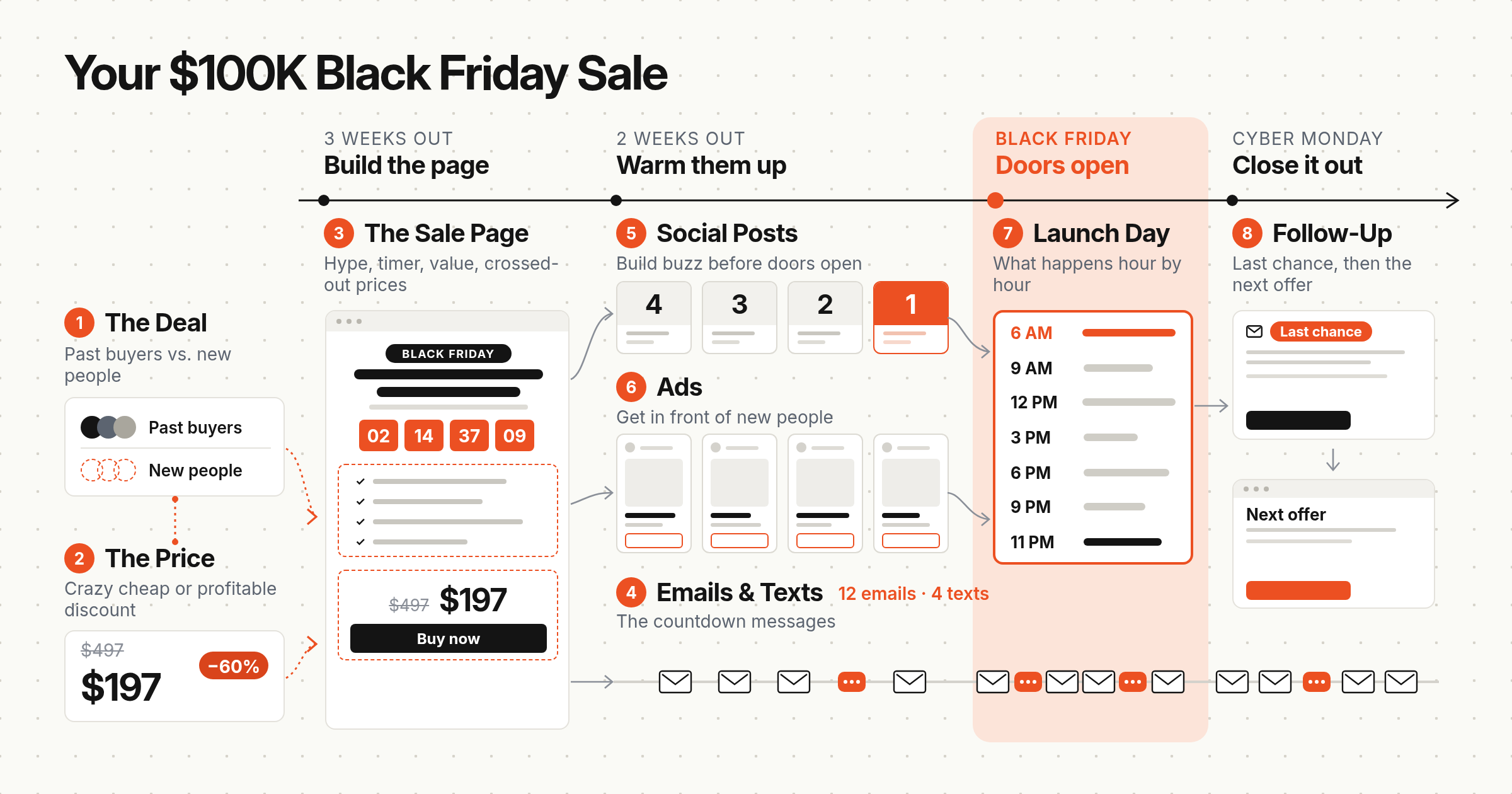
A strong Black Friday marketing strategy has 8 steps, and it starts with the two that decide everything else: your deal and your price. Here's the short answer on pricing: sell different things to past buyers and new people, build a deal that passes 4 checks, then pick one of two price paths. Go crazy cheap and sell the full-price version after, or give a real discount and add extras at checkout. Your deal matters more than your price.
I'm Brian Moran, founder of SamCart, 75,000 creators, $8B in revenue. Most owners make or break their year in Q4, and it starts with Black Friday.
And most Black Friday sales flop for one reason. People slap a discount on something, send one email, and hope.
The big ones, the six and seven figure sales, all follow the same 8-step map. In this post I'll walk you through all 8 steps. Then we'll build the first two together, your deal and your price, so you walk away with a sale ready to go.
// 01What is a Black Friday marketing strategy?
It's your plan for every piece of the sale, start to finish. What you sell, what you charge, the page people buy on, the emails, texts and posts that send them there, how you reach new people, what happens on launch day, and what you send after it's over.
Most owners only plan the discount. The sales that win plan all 8 pieces.
// 02What are the 8 steps of a Black Friday sale?
Every strong Black Friday sale has 8 pieces:
- The deal
- The price
- The sale page
- Emails and texts
- Social posts
- Paid reach on Facebook and Instagram
- Launch day
- Follow-up
This is the same map I see the top sellers on SamCart use, the ones doing anywhere from a million to a hundred million dollars a year. There are a lot of moving pieces. It starts two or three weeks out. By the time the sale opens on Black Friday, there's already a lot of hype built, maybe a waiting list, and several posts, emails and texts have gone out.
So if you're reading this in early November, you're right on time. Let's jump into steps 1 and 2. (Steps 3 to 8 are coming soon in Part 2, Part 3 and Part 4.)
// 03Step 1: What Black Friday deal should you sell, and to whom?
Sell different things to different people.
Here's the number one mistake I see: selling the exact same thing to your past buyers and to people who haven't bought from you yet.
Your buyers already trust you. New people don't yet. So why are you sending them the same sale?
What should you sell past buyers?
Sell them one of 2 things:
- A product most of them don't have yet.
- More of what they bought, if they could use more. Supplements are a great example. They can keep them in the pantry.
A few examples:
- A course seller whose buyers took the first course sells the advanced course or a coaching add-on.
- A candle shop sells a winter scent pack to people who bought the fall scents.
- A fitness coach sells a 30-day meal plan to people who already have the workout program.
- A dance studio sells extra classes on top of what families are already taking.
What should you sell new people?
Lead with your best seller.
People who haven't bought from you yet should see your top-selling, flagship product. Not a niche side item.
- A photographer leads with the most-booked mini session, not a niche package.
- A course creator leads with the flagship course, not a small add-on.
- A coffee roaster leads with the top-selling blend in a holiday bag.
// 04Why does your deal matter more than your price?
Before we get to the price, I want to be really clear: what you put in the box is way more important than the number on the tag. Most people just slap a huge discount on something. That's a mistake.
What is a Black Friday deal? Your deal is not just your product. It's everything they get with their purchase: each piece of the product, plus bonuses, included accessories, and so on.
What makes a great deal? The 4 checks
I give Alex Hormozi credit for this way of thinking about it. A great deal passes 4 checks:
- A great result.
- They're very likely to get it.
- They get the result fast.
- As little pain or effort as possible.
Here's what that looks like:
- Bakery: a dozen holiday cookies (great result), freshly made (very likely to get it), ready same day (fast), delivered to your door (no effort).
- Coach: lose your first 10 pounds (result), with a daily check-in (likely), in 6 weeks instead of guessing all year (fast), with meals already planned (easy).
What if your deal misses a check? Add a bonus
If your deal is weak on one of the 4 checks, add a bonus that fixes it:
- Same-day delivery
- A free gift with purchase
- Extra coaching sessions
And here's the part people miss: a good bonus can let you skip the discount altogether. (Made-up examples, to show the idea.)
- A $300 course stays at $300 but adds a free group call and a template pack.
- A skincare brand keeps its price and throws in a travel-size kit.
- A yoga teacher and a nutrition coach team up, bundle their programs, and split the money.
// 05Step 2: How should you price your Black Friday deal?
OK, time for the price. There are two paths. The first one will scare you.
Price path 1: When does going crazy cheap work?
Some examples (all made-up businesses, to show the idea):
- A dance studio: a whole month for $1
- A marketing agency: we run your Facebook and Instagram campaigns for 30 days for $100
- A gym: the first month for $1
- A software tool: 30 days for $1
- A supplement brand: $1 for a gallon jug
- A course creator: $1 for Golf Swing 101
By itself, you lose a ton of money. So why would anyone do this?
Because of what you sell next. What makes this crush is selling the full-price version after they buy, ideally one on one:
- The dance studio owner meets with each family about a $2,000-a-year plan.
- The agency moves happy clients to $5,000 a month.
- The gym has a trainer meet with each person about a $200-a-month yearly plan.
- The software tool rolls people into $100 a month.
- The supplement brand sells the next jug they need for $70.
- The course creator sells Golf Swing 201 for $199.
When you sit down with people who already said yes once, you might close 50 to 80 percent of them in person. That's where the money is.
This path works best when you have a real next step to sell and you (or your team) can actually talk to people after they buy.
Price path 2: How do you give a real discount that still makes money?
The second path is simpler. You give a real discount, but you still make real money on the main product. (Made-up examples again.)
- A course goes from $199 to $79.
- Sunglasses go from $299 to $229.
The key is adding extras at checkout and right after they buy. That's where the money really stacks up. Done well, it can boost what each buyer spends 3 to 5 times. For example:
- A $97 course drops to $49, plus a $27 cheat sheet, plus a $299 mega bundle.
- A $500 coaching package drops to $297, plus a $199 extra session.
- A $60 supplement drops to $39, plus a second bottle for $25.
What is each buyer worth on day one?
On my Oct 29 live, I gave a simple way to track this. Day-one buyer value is the price of your product plus how often people add the extras. Write that number on a sticky note on your desk. Then put a second sticky next to it with how high you want that number to go.
For a seller with a $44 ebook, I said the goal I'd set is probably $100 to $150 per buyer, max. Until you get there, keep adding extras or testing different versions of them: better wording, different prices. And don't panic if your first ones are weak. Version one add-ons are always the worst ones.
That one number also tells you how much you can afford to spend to reach new buyers on Facebook and Instagram, which we'll get to in Part 4.
// 06Which price path should you pick?
- Go crazy cheap if you have a bigger thing to sell next and can talk to buyers one on one (studios, gyms, agencies, coaches, subscriptions).
- Real discount plus extras if you sell products or courses where people buy online without a conversation.
- No discount, big bonus if you'd rather protect your price. Use the 4 checks and add something that fixes the weakest one.
// FAQBlack Friday marketing strategy FAQ
What is the best Black Friday marketing strategy?
Plan all 8 pieces, not just the discount: the deal, the price, the sale page, emails and texts, social posts, paid reach, launch day and follow-up. Start with your deal and your price, and start two or three weeks before the sale opens.
How much should I discount for Black Friday?
There's no magic percent. Pick a discount that still leaves you real money on the main product, like a $199 course at $79, then add extras at checkout and after purchase to raise what each buyer spends. You can also skip the discount and add a strong bonus instead.
Should I give my existing customers the same Black Friday deal as new people?
No. Your past buyers already trust you, so sell them something they don't have yet or more of what they already use. New people should see your best-selling product.
Is it worth selling something for $1 on Black Friday?
It can be, but only if you have a full-price next step to sell afterward. On its own you lose money. The profit comes from talking to those buyers about the bigger plan.
Can I run a Black Friday sale without a discount?
Yes. Keep your price and add a bonus that makes the deal better, like a free group call, a gift with purchase, or faster delivery.
When should I start planning my Black Friday sale?
The biggest sales start two or three weeks out, with hype, a waiting list and early messages before the sale opens. Start with your deal and price now.
// 08Free tools to plan your sale
- The one-page Black Friday planner: four questions and a six-week calendar, so your sale is picked, priced and on the calendar before Thanksgiving. Free, no email needed. getsam.bot/free/black-friday-planner
- The 1-Page Blueprint: the 7 parts of a page that sells, in order, for when you get to step 3. Free, no email needed. getsam.bot/free/blueprint
// 09Next in the series
You've got your deal and your price. Now people need somewhere to buy it. In Part 2 I walk you down a Black Friday sale page, top to bottom, plus 5 little-known techniques you have to use if you want your deal to sell out fast.
Read next: Part 2: How to Build a Black Friday Sale Page That Sells (5 Little-Known Tricks)
And if you'd rather someone else set up your entire Black Friday promotion for you, or any other promo you decide to run, start with SAM. Get your 3 marketing moves for this week, free: getsam.bot/audit