A sales funnel is the path a stranger takes to become a customer: they find you, they learn why you're worth trusting, they get an offer, and they buy. It's called a funnel because fewer people reach each next step. Most small businesses need just three pieces: one page that earns the email address, a short follow-up, and one page that makes the offer.
If you've ever bought something after reading a few posts, joining an email list and getting an offer a week later, you've been through a sales funnel. Every business has one. The only question is whether yours was built on purpose or left to chance.
This guide explains it in plain words, shows the stages, and gives you a small funnel you can build this week. No jargon. No 12-step diagrams.
// 01What is a sales funnel?
A sales funnel is the series of steps between "never heard of you" and "paid you." Picture a wide opening at the top where lots of people come in, and a narrow opening at the bottom where fewer come out as customers. People drop out at each step, and that's normal. Your job is to make each step clear enough that more of the right people keep going.
A funnel isn't a trick or a hack. It's just a sensible order for things: introduce yourself, be useful, make an offer, make it easy to say yes.
// 02What are the stages of a sales funnel?
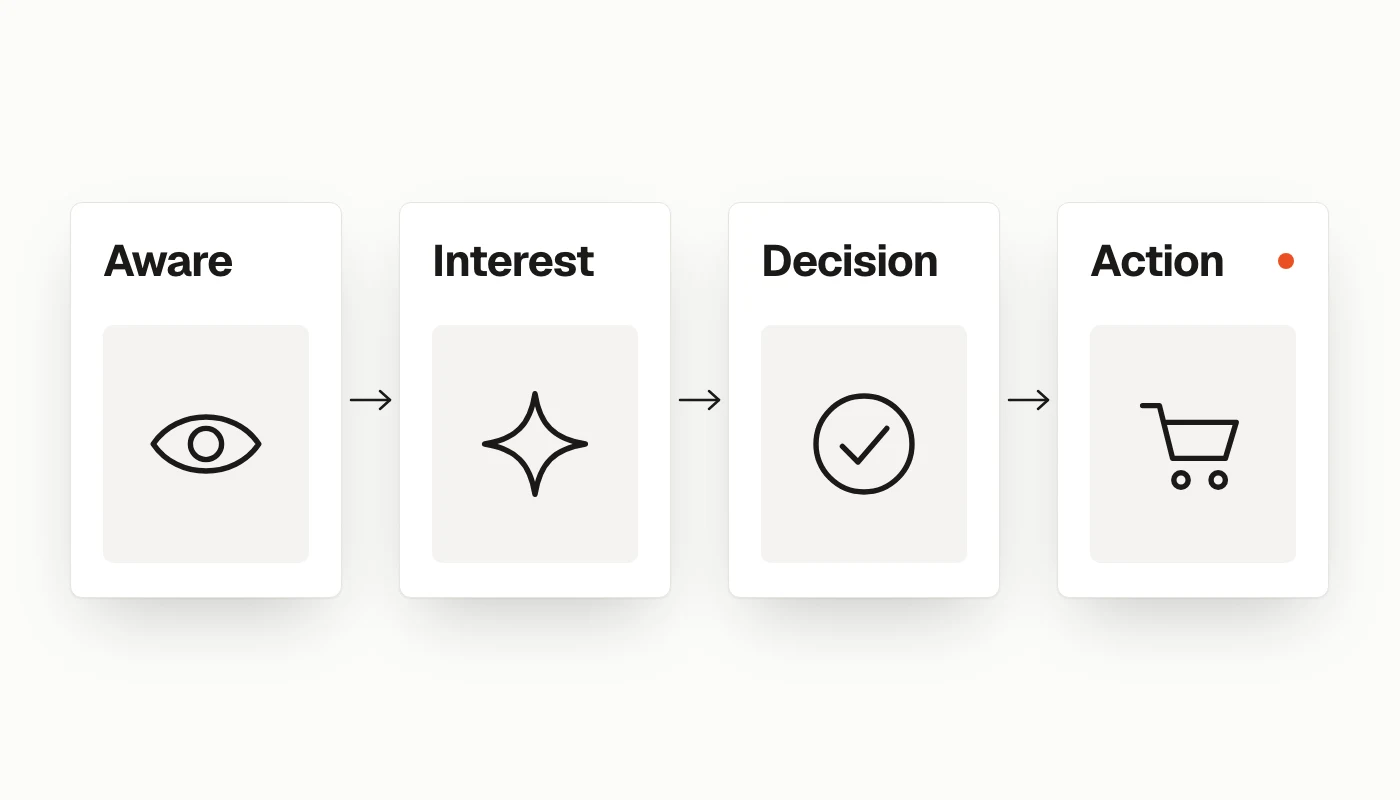
Most funnels have four stages. The names change from book to book, but the idea stays the same.
- Awareness. Someone finds you. A search result, a social post, a friend's recommendation, an ad. They don't know much about you yet.
- Interest. They look around and decide you might be useful. They read a post, watch a video or sign up for something free.
- Decision. They're thinking about buying. They want to know what it costs, what they get and whether it's right for them.
- Action. They buy, book or sign up. Then you keep going: a thank-you, a welcome email and a reason to come back.
Every page and email you write should belong to one of these stages. If you can't say which one, it probably doesn't belong in your funnel.
// 03What does a simple sales funnel look like?
Here's a small funnel that works for a lot of businesses, such as a coach, a shop owner, a local service or someone selling a digital product. It has five parts.
- Something people find. A blog post, a social post or a link in your bio. It speaks to one problem your customer has.
- A free offer on a lead capture page. A short checklist, guide, template or discount in exchange for an email address. (Here are lead magnet ideas that take hours, not weeks.)
- A thank-you page and a welcome email. The thank-you page delivers what they asked for. The welcome email says who you are and what to expect. (See how to write a welcome email sequence.)
- Two or three follow-up emails. Each one helps with the problem, shows how you solve it and links to your offer.
- An offer page. One page, one offer, one button. A sales page, a booking page or a link to your checkout.
That's a complete funnel. You can add to it later. You don't need ten more steps to start.
// 04How do you build a sales funnel, step by step?
Step 1: Pick one offer
Start at the bottom of the funnel, with what you sell. Choose one product, service or program. A funnel for everything is a funnel for nothing.
Step 2: Name one person and one problem
Who is this for, and what problem do they want solved right now? Write it in one sentence. Every step above will use it.
Step 3: Make the free thing
Pick a free offer that solves a small piece of the problem and leads naturally to your paid offer. A pricing checklist leads to a pricing service. A starter plan leads to a full program. It should feel like the first step, not a different topic.
Step 4: Build the lead capture page
One headline, a few lines on what they get, a short form and one button. Nothing else on the page: no menu, no side links. If you want to know what makes a page convert, read these landing page best practices.
Step 5: Write the follow-up emails
Send the free thing right away, then write two or three emails over the next week. Teach something, share a short story from your work, then make your offer. Keep each email to one idea and one link. (Here's the full email marketing for small business guide.)
Step 6: Build the offer page
Say what it is, who it's for, what they get, and what to do next. Answer the top three questions people ask before buying. End with one button. If you take payment through a checkout, link the button straight to it.
Step 7: Send people to the top
A funnel with no visitors is just a set of pages. Put the link in your bio, your email signature, your posts and your website. Share it where your customers already spend time.
Step 8: Check the numbers once a week
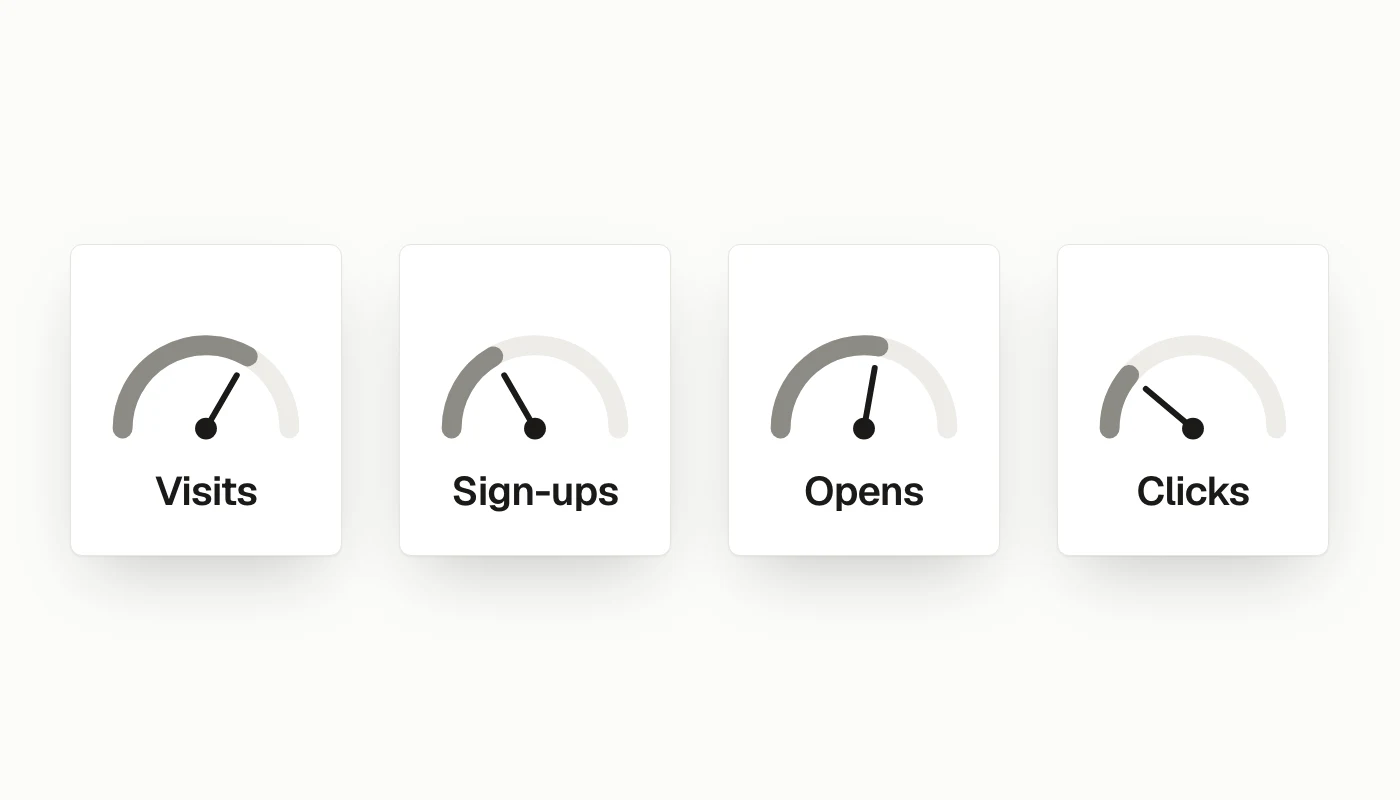
Look at how many people visit the lead capture page, how many sign up, how many open the emails and how many click through to the offer. The step with the biggest drop is the one to fix first. Change one thing at a time so you know what worked.
// 05What are the most common sales funnel mistakes?
- Too many steps. Every extra click loses people. Start small.
- Asking for the sale too early. Strangers need a reason to trust you first.
- A free offer that doesn't match the paid one. If the free thing attracts people who'd never buy, the funnel fills with the wrong crowd.
- No follow-up. Most people won't buy the first time they see your offer. Email is how you stay in touch.
- Several offers on one page. One page, one action.
- Never looking at the numbers. If you don't know where people drop off, you're guessing.
// 06Do you need special software to run a sales funnel?
No. A funnel is a plan, not a product. You need pages, a way to collect email addresses, a way to send emails and a way to take payment. Some businesses stitch these together with several tools. Others keep it in one place. What matters is that the steps connect and you can see what's happening at each one.
// 07Where SAM fits (built by the founder of SamCart)
SAM is an AI marketing team: SAM plus 5 AI specialists for ads, design, content, promotions and social. It can take a lot of the funnel work off your plate.
You start by pasting your website. SAM pulls in your logo, colors, fonts and tone of voice, and shows you what it found so you can fix anything. From then on, it learns your brand and offer from your website, and your customers and sales from the accounts you connect.
SAM builds and publishes landing pages, lead capture pages, sales pages and thank-you pages. Pages collect leads into SAM, tag them by page and source, and send them to your email list. A lead form can send a PDF when someone signs up, and SAM sends a welcome email to new leads who join through your pages. SAM also writes emails and email sequences in your brand voice, and makes the images for your pages and lead magnets. If you take payments through your own checkout, such as SamCart, a SAM page can link straight to it. SAM doesn't take payments itself. It asks for your OK before anything goes to your list.
Want to see where your funnel and the rest of your marketing stand today? Let SAM score my marketing.
SAM isn't open to you yet. Let it score your marketing.
Let SAM score my marketing// FAQFAQ
What is a sales funnel in simple terms?
It's the path from a stranger to a paying customer: they find you, they get to know you, they get an offer and they buy. It's called a funnel because fewer people stay at each step.
What are the 4 stages of a sales funnel?
Awareness, interest, decision and action. Someone finds you, shows interest, weighs the offer and then buys or doesn't.
Do small businesses need a sales funnel?
Yes, in some form. If people can find you, learn about you and buy from you in a clear order, you have a funnel. Building it on purpose just makes it easier to see what to fix.
What's the difference between a sales funnel and a marketing funnel?
They're close. A marketing funnel usually covers the top: getting attention and earning interest. A sales funnel usually covers the steps closer to the sale. Small businesses can treat them as one path.
How long should a sales funnel be?
As short as you can make it. A free offer, a short email series and one offer page is enough to start. Add steps only when the numbers show you need them.
// 08Your one thing this week
Write one sentence: "This is for [person] who wants [result], and I'll help with [offer]." Then make the free thing that fits that sentence. That's the start of your funnel.